This steps marks an important milestone for innosabi - and for our customers.
Collaboration.Ai has acquired innosabi.
This step builds on an established partnership and a shared conviction: innovation only delivers real value when the right people, ideas, and expertise are connected - and when teams can operate with clarity under real-world complexity.
Our collaboration isn’t theoretical. Over the past several years, customers have already demonstrated the value of combining innosabi’s structured innovation management with Collaboration.Ai’s network- and AI-driven capabilities. Products like CrowdVector (innosabi Idea), powered by innosabi and brought to market together with Collaboration.Ai, are tangible proof that this joint approach works.
At innosabi, we’ve long supported organizations across the full innovation lifecycle—from insight discovery and idea development to collaboration, evaluation, and delivery. As we are now part of Collaboration.Ai, that proven foundation grows stronger. Our platform will continue to serve customers with the same teams and products, while gaining access to deeper agentic AI capabilities, graph-based intelligence, and a more unified platform vision.
Together, we’re moving toward a connected innovation system designed for scale, reliability, and execution—especially when stakes are high and conditions are constantly changing.
The next chapter is about evolving from successful innovation initiatives into a resilient, end-to-end innovation system that holds up in the real world.
Together with the full team, I’m looking forward to building this future together with our customers and partners.
Jan Fischer
Managing Director, innosabi
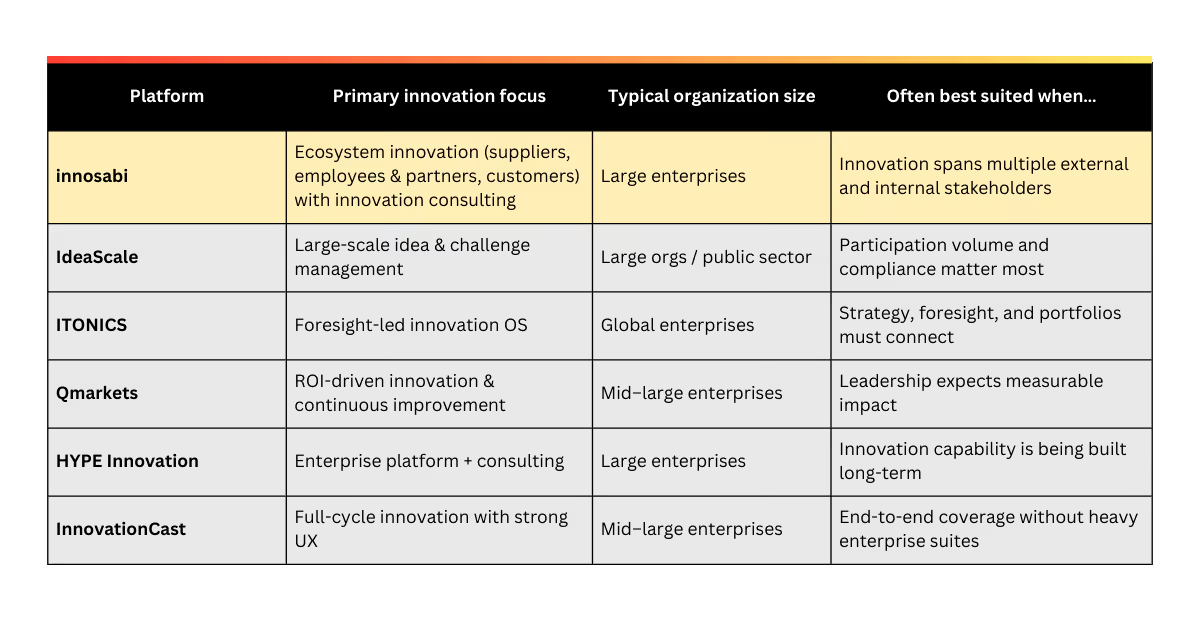
Choosing the right innovation management platform is about finding a partner that aligns with how your organization innovates today and where you want to go tomorrow.
This guide provides an honest assessment of seven leading platforms in the innovation management space. We've structured each profile to help you quickly understand what each platform does best, who it's built for, and where it might fall short for your specific needs.
Whether you're launching your first innovation program or replacing an existing system, you'll find practical insights to guide your evaluation.
Start by identifying your primary innovation challenge (ecosystem collaboration, strategic foresight, ROI measurement, or rapid idea capture). Each platform profile is structured consistently to help you quickly compare capabilities, ideal customer fit, and trade-offs.
As you read, consider not just your current needs, but also your organization's innovation maturity and where you want to be in two years. The right platform should meet you where you are today while supporting your growth tomorrow.
This snapshot is meant to orient your evaluation. The sections that follow explore each platform’s strengths, limitations, and trade-offs in more detail.

This snapshot is meant to orient your evaluation. The sections that follow explore each platform’s strengths, limitations, and trade-offs in more detail.
What they do: innosabi brings together your internal innovation efforts with the outside world (suppliers, startups, and customers) all in one place. Recently joined by Collaboration.Ai in January 2026, the platform now combines ecosystem innovation with AI capabilities to help you discover insights, generate ideas, and manage innovation projects from start to finish.
Best for: Large enterprises juggling multiple stakeholders in their innovation programs, especially companies in automotive, energy, pharma, and industrial sectors that need to collaborate across employees, partners and suppliers networks. Very strong fit for organisations in the governmental and defence section.
Key strengths:
Notable capabilities:
Considerations:
Security & compliance: Built for enterprise security with GDPR compliance. Trusted by regulated industries including defense, energy, and financial services. Request detailed security documentation during your evaluation process.
What they do: IdeaScale pioneered crowdsourcing for innovation, making it easy to collect ideas from employees, citizens, and partners at scale. Since 2009, they've become the go-to platform for government agencies and organizations that need to engage large, diverse audiences in their innovation efforts.
Best for: The platform promotes a collaborative environment in which users can submit, discuss, and prioritize ideas, making the innovation process more efficient.
Key strengths:
Notable capabilities:
Considerations:
Security & compliance: FedRAMP compliant for government deployments with NIST 800-171 alignment. Note: Validated through federal frameworks rather than commercial certifications like SOC 2 or ISO 27001.
What they do: ITONICS bills itself as your complete "Innovation Operating System", connecting the dots between what's happening in the world (foresight), what ideas your team has (ideation), what you're actually working on (portfolio), and where you're headed (roadmapping). It's innovation management for organizations that think systematically.
Best for: Global enterprises with formal innovation programs, especially R&D-intensive companies in manufacturing, automotive, pharma, and tech. If you need to connect strategic foresight to actual project execution, ITONICS is built for that.
Key strengths:
Notable capabilities:
Considerations:
Security & compliance: ISO/IEC 27001:2022 certified with transparent Trust Center documentation covering everything from audit logs to penetration testing. GDPR-compliant by design.
What they do: Qmarkets built its platform around a simple question: how do we prove innovation's impact? Their modular suite covers idea management, continuous improvement, trend monitoring, startup scouting, and portfolio tracking, all with ROI measurement baked in from the start.
Best for: Mid-to-large enterprises that need to show clear returns on innovation investment, especially in manufacturing, finance, healthcare, and energy. If your leadership asks "what are we getting from this program?", Qmarkets is built to answer that question.
Key strengths:
Notable capabilities:
Considerations:
Security & compliance: Enterprise-grade security with on-premise options available for strict hosting requirements. Request formal ISO/SOC documentation as part of your evaluation.
What they do: HYPE combines innovation software with hands-on consulting, treating innovation management as a discipline you build over time rather than a tool you just install. Born from DaimlerChrysler in 2001, they serve 300+ enterprises with a full-service approach that includes training, community, and ongoing advisory.
Best for: Large global enterprises that want a long-term innovation partner, not just a software vendor, especially valuable if you're building innovation capabilities from scratch or transforming how your organization approaches innovation.
Key strengths:
Notable capabilities:
Considerations:
Security & compliance: ISO/IEC 27001 certified with annual renewals. Strong governance features for enterprises with complex approval chains and risk management needs.
What they do: InnovationCast aims to make innovation management feel less like work and more like collaboration. Their platform covers the full innovation lifecycle, from scanning the environment for opportunities to managing projects through execution, with a focus on automation and UX.
Best for: Mid-size and large companies that want comprehensive innovation management without the complexity of multi-module enterprise suites, particularly strong for European organizations needing multi-language support.
Key strengths:
Notable capabilities:
Considerations:
Security & compliance: ISO 27001-certified Information Security Management System. Positioned as ready for ISO 56001/56002 innovation management standards.
.avif)
The most successful programs connect internal capabilities with external ecosystems (suppliers bringing fresh solutions, startups pushing boundaries, and customers co-creating what they actually need).
innosabi is built for this reality.
Organizations choose innosabi when they need more than idea management; when they're running complex, multi-stakeholder innovation programs that span their entire ecosystem. The modular platform grows with organizations as they scale, whether starting with employee ideation or building a comprehensive innovation engine that includes supplier challenges, community Managementand customer co-creation.
While other platforms added external collaboration as an afterthought, innosabi was built from the ground up to connect internal teams with suppliers,communities, and customers. The Partner and Community modules are complete innovation management systems designed for ecosystem collaboration.
Following the January 2026 acquisition by Collaboration.Ai, innosabi is integrating graph-based intelligence and agentic AI that makes connections teams might miss. It's AI designed to make innovation teams more effective.
innosabi works with organizations in automotive, energy, pharma, and defense because the platform understands regulatory requirements,, and the change management needed to transform how large organizations innovate. Organizations like Coca-Cola, Lufthansa, BASF, NASA and the U.S. Air and Space Forces rely on innosabi to accelerate progress and create a lasting impact.
Want to learn more about innosabi's modular approach? Book a demo with our innovation specialists.
Innovation management is entering a new phase.
For years, digital platforms helped organizations collect ideas, structure workflows, and manage portfolios. AI added efficiency: faster clustering, smarter search, automated summaries.
Now a deeper shift is underway.
Agentic AI is not just accelerating existing processes. It is changing how innovation systems are designed, governed, and scaled inside large enterprises.
We believe that this is not a tooling upgrade. It is a structural transformation.
Below are five strategic dimensions innovation leaders must understand to navigate this shift.
Large enterprises have traditionally separated innovation and transformation.
Innovation teams explored new products, services, and business models.
Transformation teams reshaped culture, processes, and digital capabilities.
In practice, both relied on similar mechanisms:
The difference was not the system. It was the objective. With agentic AI, that distinction begins to dissolve.
When AI continuously evaluates opportunity spaces, simulates scenarios, and supports capital allocation, innovation becomes embedded in the transformation engine itself. The system does not merely capture ideas. It actively guides investment decisions.
Traditional innovation platforms track:
With an agentic AI layer on top, the platform evolves into something more powerful: A continuously learning investment engine.
It analyzes signals across markets, internal projects, external ecosystems, and operational data. It supports smarter capital allocation. It reduces bias. It increases transparency.
The implication is significant.
Innovation leaders move from managing stage gates to orchestrating intelligent capital deployment. They become relationship architects between strategy, finance, engineering, and operations.
Innovation and transformation are no longer parallel tracks. They converge in the design of an adaptive enterprise system.
There is little debate that AI increases productivity. It accelerates research cycles, enhances insight generation, and improves decision quality. The question is not whether AI is a force multiplier. It clearly is.
The real question is whether organizations can govern that multiplier.
In regulated industries especially, unbounded experimentation is not an option. Agentic AI must operate within clearly defined enterprise constraints. It must be auditable, transparent, and aligned with strategic KPIs. It must respect access rights, compliance structures, and portfolio governance models already in place.
Enterprise-grade AI differs fundamentally from consumer AI. It cannot function as an opaque black box. Its logic, data sources, and decision paths must be understandable.
At the same time, the greatest strategic risk may not be AI itself, but poorly framed human questions. If organizations scale flawed assumptions, they amplify error. If they use AI to pressure-test hypotheses, simulate scenarios, and refine strategic inquiry, they dramatically improve decision quality.
Agentic AI, in this sense, becomes a decision simulator. It shifts humans from operators of processes to designers of intelligent systems.
Every productivity revolution in history has reshaped roles rather than eliminated value creation. The same pattern is emerging here. The multiplier is neutral. Governance determines whether it becomes a competitive advantage or systemic risk.
We at innosabi together with Collaboration.AI have proven that our systems, technology and consulting has the highest governance standard when working successfully together with NASA or U.S. Air and Space Forces.
“Garbage in, garbage out” remains a valid concern. Innovation deals with ambiguity, weak signals, and incomplete data. Human accountability cannot disappear.
But constant manual oversight does not scale.
The emerging model is governed autonomy. Instead of placing guardrails outside the system, organizations embed them within it. Agents operate within defined parameters. Data access is controlled. Behavior is transparent. Escalation paths are predefined.
Just as innovation management matured through standardized methodologies, agentic AI will require validated agent frameworks. Organizations will define and refine trusted configurations for clustering ideas, scouting technologies, simulating portfolio scenarios, and evaluating capital efficiency.
Governed autonomy does not mean removing humans from the loop. It means designing systems where autonomy operates within enterprise constraints. Innovation does not slow down, but it does not lose accountability either.
The balance between control and flexibility becomes a design challenge rather than a political one.
Open innovation has long been fragmented. Internal idea programs, startup scouting, supplier collaboration, and university partnerships were typically managed as distinct initiatives. Each required manual orchestration, significant coordination, and heavy governance.
Agentic AI changes the scale equation.
It can analyze thousands of startups, map external capabilities against internal projects, detect complementary technologies, and surface partnership hypotheses at machine speed. The boundary between inside and outside innovation begins to dissolve.
Open innovation becomes systemic rather than episodic.
Instead of running isolated campaigns, organizations orchestrate a dynamic ecosystem. Ideas flow across corporate boundaries. Agents detect complementarities faster than any human team could. The innovation ecosystem becomes fluid and composable.
For large enterprises, this marks a transition from managing programs to managing networks - where the power of Collaboration.AI and its product NetworkOS lives.
Perhaps the most compelling moment of the conversation was Jan’s example of the blue collar worker.
A frontline employee identifies a mechanical improvement. Using AI, he narrows material options to three viable candidates before engaging engineering.
The engineer still validates the decision.
But the ideation threshold has dropped dramatically.
Agentic AI lowers the barrier to participation.
Distributed innovation is no longer a slogan. It becomes operational reality.
Innovation leaders can now detect entrepreneurial friction in real time.
For highly educated innovation managers in large enterprises, the implications are strategic:
The core capability shifts from managing ideas to designing intelligent systems.
The organizations that succeed will not simply deploy AI tools. They will architect governed, modular, composable innovation ecosystems with agents embedded at every layer.
Agentic AI does not eliminate the role of innovation leadership. It raises it.
Innovation managers become:
In short, the future of innovation management is not about replacing human judgment.
It is about augmenting it with continuously learning systems that operate at a scale no human team ever could.
And as the LinkedIn Live made clear, we are still at the beginning of defining that playground.
The question is no longer whether agentic AI will shape innovation.
The question is whether your organization will design that system intentionally.


Innovation is not a single act of creativity. It is a structured capability. Organizations that outperform their markets understand that innovation takes different forms, serves different strategic purposes, and requires different management approaches.
At innosabi, now part of Collaboration.AI since January 2026, we work with global enterprises that manage complex innovation portfolios across business units, regions, and ecosystems. One consistent insight emerges: successful companies deliberately balance four core types of innovation.
Incremental, adjacent, disruptive, and radical innovation each play a distinct role in long term competitiveness. Understanding the differences is not academic. It is essential for strategic execution.
Incremental innovation strengthens the core business. It focuses on continuous improvement of existing products, services, processes, or business models.
This is where most innovation budgets are spent. It is also where many organizations underperform, not because ideas are missing, but because execution lacks structure and transparency.
Incremental innovation typically aims to:
A well known example is Apple’s systematic evolution of the iPhone. Each release introduces measurable enhancements. Individually they may appear small. Collectively they reinforce market leadership and customer loyalty.
In large enterprises, incremental innovation requires more than suggestion boxes. It demands scalable idea management, structured evaluation workflows, and cross functional collaboration.
This is precisely where platforms like innosabi create impact. By connecting employees, experts, and decision makers in a structured innovation environment, organizations transform scattered ideas into measurable business outcomes. Incremental innovation becomes a managed capability rather than a coincidence.
Adjacent innovation builds on existing competencies while targeting new markets, customer segments, or use cases. It leverages what the organization already does well and applies it in a new context.
Strategically, adjacent innovation helps companies:
Starbucks provides a classic example. The company extended its coffee expertise from retail stores into packaged goods sold through supermarkets. The brand, supply chain knowledge, and product expertise remained central. The market context expanded.
In enterprise environments, adjacent innovation often requires collaboration beyond organizational boundaries. Business units, regional entities, and external partners must align around shared opportunities.
Through innosabi’s ecosystem and community capabilities, organizations can connect internal expertise with external stakeholders, suppliers, research institutions, and industry partners. This structured collaboration accelerates adjacent growth while maintaining governance and transparency.
Disruptive innovation introduces offerings that initially appear inferior to established solutions but ultimately redefine market expectations.
These innovations:
Netflix exemplifies this shift. Beginning with DVD by mail and later pivoting to streaming, it gradually displaced traditional video rental businesses. The disruption was not instantaneous. It was cumulative and technology enabled.
Disruption is rarely accidental. It requires organizations to detect weak signals early, explore alternative business models, and allocate resources beyond the core.
This is where the integration of innosabi into Collaboration.AI becomes strategically significant. Collaboration.AI extends innovation management with advanced AI capabilities that support signal detection, knowledge synthesis, and opportunity identification across vast data landscapes.
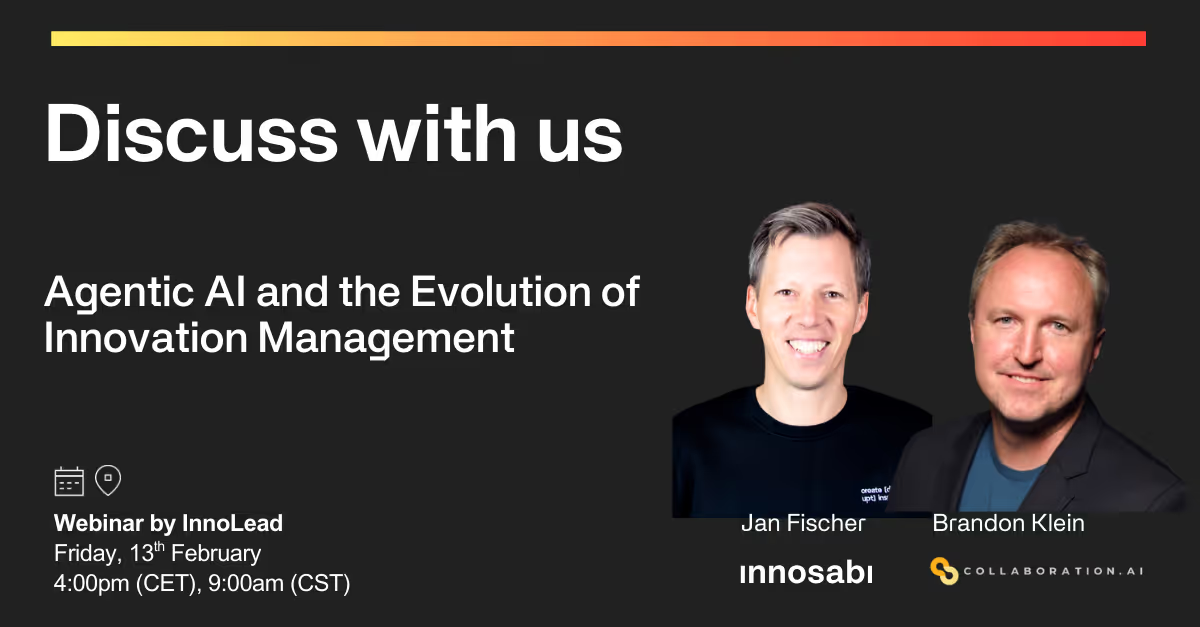
In a recent webinar, Jan and Brandon discussed levels of AI maturity in innovation management. At the foundational level, AI supports efficiency by automating categorization, clustering, and analysis. At the advanced level, AI augments human decision making by identifying patterns across markets, technologies, and internal knowledge bases. At the highest level, AI becomes a strategic co pilot that helps organizations simulate scenarios, assess risk, and prioritize innovation portfolios based on dynamic data.
Disruptive innovation thrives when organizations move beyond isolated ideation and toward AI augmented strategic foresight.
Radical innovation introduces fundamentally new technologies, concepts, or business models that reshape industries.
Unlike incremental or adjacent innovation, radical innovation often:
The smartphone transformed communication, media consumption, and digital services. It did not simply improve existing devices. It redefined behavior, ecosystems, and value creation.
Radical innovation cannot be managed with the same governance models as incremental improvements. It requires protected exploration spaces, cross disciplinary collaboration, and executive sponsorship.
Enterprises that successfully pursue radical innovation combine structured innovation processes with strategic intelligence. AI driven insights, external knowledge integration, and portfolio transparency are critical.
Through the combined capabilities of innosabi and Collaboration.AI, organizations can connect internal exploration with external data, expert networks, and emerging technology signals. Radical initiatives become embedded in a broader innovation portfolio rather than isolated experiments.
While the four types describe strategic intent, innovation success depends on organizational capability. Three complementary perspectives are particularly relevant.
In practice, leading organizations integrate all of these perspectives into a coherent innovation management system supported by digital platforms and AI augmentation.
Innovation management has evolved significantly. It is no longer sufficient to collect ideas. High performing organizations build intelligent innovation systems.
Three developments define the current landscape:
AI supports idea clustering, trend analysis, knowledge discovery, and portfolio prioritization. At higher maturity levels, AI enables strategic simulations and dynamic scenario modeling, as discussed in the recent webinar by Jan and Brandon.
Innovation increasingly happens across organizational boundaries. Structured collaboration with partners, research institutions, and industry networks is essential.
With innosabi as part of Collaboration.AI, enterprises gain access to a broader ecosystem and AI enhanced collaboration infrastructure that connects strategy, knowledge, and execution.
Innovation strategies must align with environmental and societal expectations. Sustainable innovation is no longer a niche initiative. It is central to resilience and competitiveness.
Incremental innovation strengthens the core.
Adjacent innovation expands growth horizons.
Disruptive innovation challenges industry logic.
Radical innovation creates new realities.
Leading organizations do not choose one. They orchestrate all four within a transparent, data informed innovation portfolio.
With the integration into Collaboration.AI, innosabi extends its role from innovation management platform to intelligent innovation infrastructure. By combining structured collaboration with advanced AI capabilities, enterprises can move from isolated initiatives to systemic, strategic innovation.
Innovation is not about isolated breakthroughs. It is about building an organization that can continuously sense, decide, and act in a changing environment.


Article Takeaways
Let's address the tension directly.
You've seen the headlines. Thousands of tech layoffs in the past year. Companies "rebalancing" as they push into AI. Budgets tightening. Teams shrinking. And somewhere in a leadership meeting you weren't invited to, someone probably asked: "Do we still need an innovation team, or can AI just handle this?"
If you're an innovation manager right now, that question probably keeps you up at night.
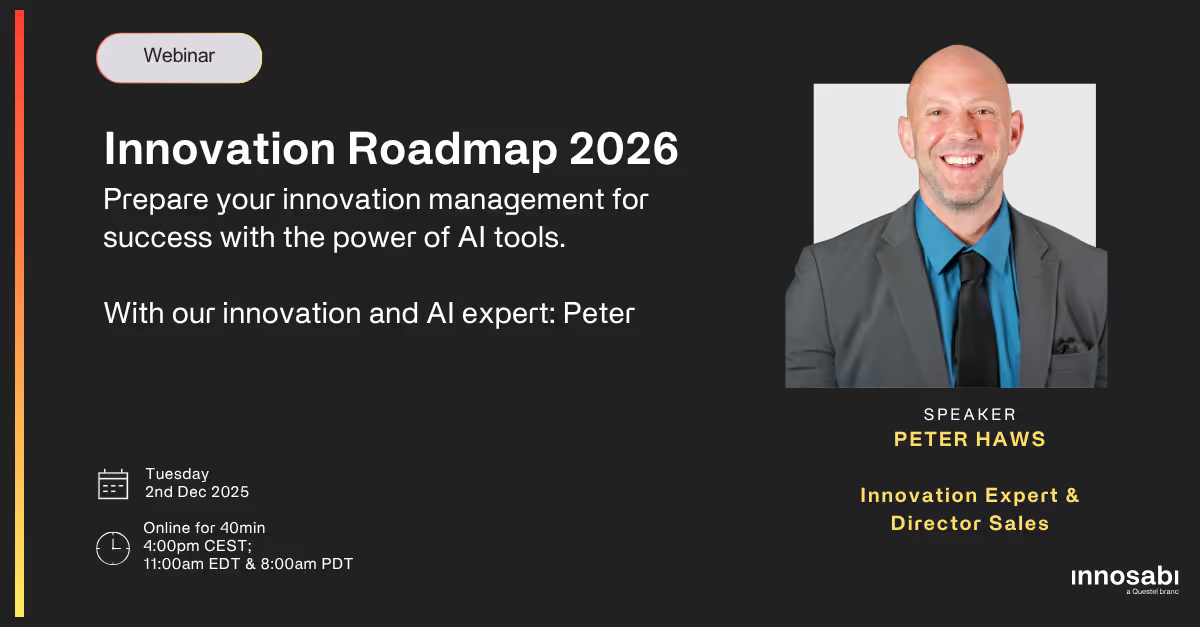
This tension was the opening focus of a recent innosabi webinar on innovation roadmaps for 2026. The Peter [LAST NAME, POSITION] acknowledged it directly: "Innovation leaders are facing increased pressure: shrinking budgets, smaller teams, and growing fears that AI may replace entire functions."
Here's what you need to know: innovation roles aren't disappearing, but they are transforming, and that transformation might be the most important shift your organization makes in 2026
For years, innovation managers were essentially idea collectors. You ran suggestion boxes, maybe launched an annual challenge, managed spreadsheets full of submissions, and tried to get a few promising ideas in front of decision-makers.
The process was largely reactive. Someone submitted an idea. You categorized it, evaluated it, maybe ran it through a committee. Most ideas went nowhere. The good ones got stuck in bureaucracy. And when leadership asked about ROI, you pointed to the three projects that actually launched.
This model made sense when innovation moved slowly, when challenges were sequential, when capturing ideas was the hard part.
That world is gone. And the new world requires a fundamentally different approach.
Organizations today don't have a single innovation priority; they now have ten running simultaneously. Sustainability initiatives, customer experience improvements, digital transformation projects, cost optimization challenges, quality control overhauls, new product development. All happening at once, all demanding attention, all requiring coordination.
Meanwhile, AI has made certain tasks dramatically faster: analyzing data, clustering submissions, identifying patterns, checking compliance, synthesizing research. The work that used to consume 60% of your time (the manual sorting, the pattern hunting, the repetitive analysis) can now happen in a matter of minutes.
The innovation manager of 2026 isn't managing single projects anymore. You're orchestrating entire ecosystems where multiple innovation tracks run in parallel, AI accelerates specific workflows, and human expertise flows across boundaries that used to be walls.
As the webinar emphasized, the future of innovation management requires leaders who can "orchestrate the entire innovation ecosystem" and "build a system where AI and humans can work together
Consider what happens when a quality issue emerges across multiple facilities.
The old approach: launch a challenge, collect submissions, manually review everything, identify themes, present findings to leadership weeks later.
The orchestration approach: create the environment where operators, engineers, and procurement specialists can contribute insights as the challenge runs. Deploy AI to cluster related submissions in real-time, surface patterns, and highlight which ideas align with regulatory requirements. Connect the dots between what AI analysis reveals and what humans know from experience. Enable cross-functional teams to build on each other's thinking, not just submit isolated ideas.
Your job isn't to personally solve the quality issue. Your job is to create the conditions where the solution emerges faster, better, and with broader buy-in than any single expert could achieve alone.
This transformation requires capabilities most innovation managers weren't trained for.
Here's what actually matters now:
You need to see how different innovation initiatives connect, where insights from one track could accelerate another, how to prevent redundant work across parallel challenges. This means understanding dependencies, designing information flows, and creating feedback loops between AI-driven analysis and human context.
This doesn't mean you need to code. It means knowing when AI adds value and when it doesn't. Understanding which problems need algorithmic pattern recognition versus which require human judgment. Recognizing that AI can only work with accessible information, and building the collaboration infrastructure that makes institutional knowledge accessible in the first place.
Getting people to participate once is easy. Building a system where participation becomes habitual requires understanding psychological barriers, designing for different contributor types, reducing friction at every step, and showing people their input leads to visible outcomes. This is half psychology, half process design.
You need to articulate innovation's value in business terms leadership actually cares about: reduced time-to-decision, implementation rates, cost savings from incremental improvements, knowledge retention metrics, competitive positioning. You're connecting what happens in your innovation ecosystem to outcomes that matter in board meetings.
Here's the paradox: as AI handles more tactical work, the orchestrator role becomes significantly more strategic and essential.
Leadership can buy AI tools. What they can't buy is someone who understands how to integrate those tools into culture, workflows, and existing systems. They can't buy someone who knows how to engage a skeptical frontline workforce or capture institutional knowledge before experienced employees retire. They can't buy someone who can design innovation ecosystems that actually function across organizational silos.
That's you. That's the opportunity.
AI usage boosts employee innovation behavior when people feel more capable and supported, not replaced. Your job is creating that environment. AI structures the noise. You provide the meaning, the context, the human judgment that makes innovation relevant rather than just interesting.
The webinar's conclusion captured this evolution perfectly: "The future isn't innovation or AI. It's innovation powered by AI… and guided by humans who know how to use it."
As we look toward 2026, one pattern is evident: organizations that succeed will integrate what used to be false choices: ideas with execution, humans with AI, incremental improvements with breakthrough innovation.
They'll build systems where all those elements work together continuously. Where multiple innovation tracks operate in parallel. Where AI accelerates specific analytical workflows while humans contribute the institutional knowledge that no database captures. Where feedback loops ensure continuous learning between what AI surfaces and what humans understand from context.
These organizations need someone designing that system. They need an architect for the entire innovation ecosystem.
They need orchestrators, not collectors.
If you're feeling pressure about AI replacing your function, channel that anxiety into a different question: Am I positioned as a collector or an orchestrator?
If your primary value proposition is managing spreadsheets and running annual challenges, yes, you should be concerned. That work is being automated.
But if you're designing how innovation flows through your organization, connecting AI capabilities with human collaboration, creating systems that engage diverse expertise, and translating all of it into business outcomes, you're increasingly indispensable.
Your role isn't disappearing. But it certainly evolving into something considerably more important.
Watch the full webinar to see how leading innovation managers are building orchestration capabilities for 2026, or schedule a demo to discover how innosabi's platform enables the shift from idea collection to ecosystem orchestration.


Article Takeaways
Every strategy meeting follows the same pattern lately.
Someone presents the innovation priorities: sustainability, customer experience, digital transformation, cost reduction. Leadership nods. Then comes the inevitable question: "Can't AI just do most of this for us now?"
Cue the awkward silence. Because the honest answer is: it's complicated.
Sure, AI can accelerate certain innovation tasks dramatically, analyzing data, identifying patterns, clustering hundreds of submissions. But it can't replace the institutional knowledge your operators carry, the cross-functional collaboration that surfaces breakthrough solutions, or the human judgment that separates good ideas from genuinely transformative ones.
So how do you build an innovation roadmap that leverages AI's power without ignoring the irreplaceable value of human expertise? A recent innosabi webinar on innovation roadmaps tackled exactly this challenge, offering a practical framework that balances both
The answer isn't choosing one over the other. It's designing a system where both work together, continuously, strategically, and measurably.
Here's the five-step framework to make that happen.
When most people think about innovation, they picture launches: the next iPhone, radical breakthroughs that reshape industries. Those matter. But inside most global organizations, the majority of innovation is actually incremental.
Fixing a recurring defect. Improving workflow efficiency. Reducing scrap rates by X%. Shortening onboarding time. Individually, these improvements feel small. Collectively, they're transformative. And done consistently over time, incremental innovation is what protects competitive edge.
A recent webinar by innosabi made this clear: "Innovation isn't disappearing, it's evolving into a more structured, connected, and intelligent discipline that integrates AI without replacing human expertise."
And the 2026 roadmap isn't about choosing between breakthrough and incremental, or even between AI and humans. It's about building the infrastructure where both can thrive simultaneously.
Next, let’s go over this, step-by-step.
Before you can build a roadmap, you need to understand where you currently stand across two critical dimensions.
Vertical innovation is specific, targeted, and analytical. This is where AI thrives:
Horizontal innovation is collaborative, creative, and community-driven. This is where humans excel:
Most companies only operate vertically; they run isolated projects with specific timelines. Then they wonder why progress feels slow and insights stay trapped in silos.
So assess honestly: Where are you strong? Where are you weak?
Not every innovation challenge needs the same approach. The key is matching the right tool to the right problem type.
Deploy AI for problems with:
Rely on human collaboration for problems involving:
And here's the critical insight: most complex problems require both. AI can identify that customer complaints spiked X% in Q3, but it can't tell you what the sales team heard directly: "The new feature works great, but the onboarding sequence confuses people in the first 48 hours."
It's clear that the dispute isn't AI or humans. It's how to create the environment where each contributes what they do best.
Organizations today have multiple priorities at once: sustainability, customer experience, digital transformation, cost optimization, quality control, new product development. The list goes on.
In the past, innovation was sequential: one challenge, one group, one timeline. In contrast, the future model runs multiple horizontal innovation tracks simultaneously, each supported by AI-driven vertical workflows.
What this looks like in practice:
This transforms innovation from a single project into an ecosystem. Knowledge flows across initiatives. Insights cross-pollinate. Redundancy decreases. Breakthroughs accelerate. And leadership finally gets visibility across everything, not just isolated reports.
Here's where most roadmaps fail: they create multiple innovation initiatives but provide no connecting infrastructure. Teams end up submitting ideas through email, spreadsheets, hallway conversations, and disappearing comment threads.
Patterns exist, but no one can see them. Solutions exist, but they stay local. Knowledge exists, but lives in individuals, not systems.
AI usage can boost employee innovation behavior when people feel more capable and supported (not replaced). The infrastructure you choose should enable both: AI acceleration and human confidence.
The most sophisticated roadmap doesn't stop at infrastructure, it goes beyond. It creates continuous learning cycles between your vertical AI capabilities and horizontal human collaboration.
Here's an example how feedback loops work: AI clusters 500 submissions from your quality improvement challenge and identifies that 40% relate to a specific supplier issue. This insight flows back to the human team, who recognize this aligns with a recent material change the procurement lead mentioned. The combined insight triggers a targeted vertical analysis: AI runs compliance checks on alternative suppliers while humans assess relationship and contract implications.
Without the feedback loop, AI produces insights that sit unused. Human discussions happen without data-driven validation. With the feedback loop, each layer enhances the other continuously.
Your role as an innovation leader shifts fundamentally. You're not personally solving every challenge. You're not the inventor or the gatekeeper. You're the architect of the whole ecosystem; the one designing how innovation flows, which is considerably more important.
As emphasized in the webinar, organizations that win "won't choose between ideas or execution, humans or AI, incremental or breakthrough. They'll build systems where all those elements work together continuously."
This is the roadmap: structured collaboration infrastructure that captures institutional knowledge, AI-powered workflows that accelerate analysis and pattern recognition, multiple innovation tracks running in parallel, and feedback loops that ensure continuous improvement.
The future isn't innovation or AI. It's innovation powered by AI and guided by humans who know how to orchestrate both.
Strategy defines your overall approach and priorities (what and why). The roadmap is your execution plan: specific initiatives, timelines, and infrastructure (how and when).
Track submission volume and quality, time-to-decision, implementation rate, employee engagement across departments, and business impact (cost savings, revenue, process improvements). Leading organizations also measure knowledge retention (i.e. capturing institutional expertise before employees leave).
Both. Top-down sets strategic priorities and allocates resources. Bottom-up captures frontline insights and surfaces problems leadership may miss. Effective infrastructure enables strategic challenges while allowing any employee to submit ideas outside formal campaigns.
Review annual roadmaps quarterly at minimum, adjusting for business changes. But innovation infrastructure should operate continuously, not just during planning cycles. This continuous operation lets you adapt roadmaps based on real-time insights rather than annual guesswork.
Watch the full webinar to see the complete framework in action, or schedule a demo to discover how innosabi's platform connects horizontal collaboration and vertical AI workflows in a single innovation ecosystem.
Article Takeaways
Product quality is drifting across your facilities. Three different regions are reporting variations in the same process. Customer complaints are clustering around issues that shouldn't exist with your current specifications.
The data is overwhelming. The pattern is clear. And the solution feels obvious: deploy AI to analyze everything; defect logs, supplier performance metrics, maintenance records, process data. Let the algorithm find what humans are missing.
This is the exact scenario discussed in a recent innosabi webinar on innovation roadmaps, where a prevailing sentiment surged: "At this point, someone well-intentioned says, why can't we throw AI at the problem?"
It's a reasonable instinct. AI excels at processing massive datasets, identifying patterns at scale, and synthesizing information faster than any human team.But here's the catch, and one of the biggest challenges to ai adoption that organizations overlook: AI can only work with information it can access.
And the critical knowledge your organization needs to solve complex innovation challenges? Most of it doesn't live in databases.
It lives in the operator who remembers when the material supplier changed three months ago. In the engineer who knows why a similar idea failed five years back. In the procurement lead who understands the regulatory constraints no one documented.
So before you deploy AI to tackle your next innovation problem, here are the critical ai adoption questions every innovation leader should ask:
Think of your organization's knowledge as an iceberg. The 10% visible above water represents accessible information, what lives in databases, reports, structured logs, and documented systems. This is AI's playground. It can process this data at remarkable speed, finding patterns human analysts might miss.
But 90% of your organization's knowledge sits below the surface: institutional knowledge that exists only in people's heads.
Consider a global manufacturing scenario: Leadership launches a coordinated innovation challenge to address quality inconsistencies across five plants worldwide. AI can analyze structured data, production metrics, defect rates, supplier certifications, compliance logs. That's valuable.
But here's what AI cannot access:
The bottom line: If the information AI needs to solve your problem lives primarily in undocumented human experience, you don't have an AI problem. You have a knowledge capture problem.
Once you recognize that critical knowledge lives in people, not systems, the next question becomes: which people?
Innovation challenges rarely get solved by a single department or expertise area. The breakthrough often emerges from connecting insights across roles that don't normally collaborate:
Without a structured way to engage these diverse knowledge holders, you end up with ideas arriving through email, spreadsheets, hallway conversations, and disappearing comment threads. Patterns exist, but no one can see them. Solutions exist, but they stay local. Knowledge exists, but lives only in individuals.
This is why the question isn't "AI or humans?". It's "How do we create the environment where humans can share what they know, and AI can help us make sense of it?"
As the webinar highlighted: "AI structures the noise while humans provide the meaning." But that partnership requires infrastructure, platforms where cross-functional teams can contribute ideas, share insights, build on each other's thinking, and make tacit knowledge visible.
And here's where most organizations miss the complete picture. They tend to focus exclusively on vertical innovation, those specific, targeted, analytical tasks where AI agents thrive:
This vertical layer is essential. But it's insufficient.
The horizontal layer is where community collaboration and creativity happen:
The real mistake is treating vertical AI capabilities and horizontal collaboration as a trade-off. The teams getting it right are building for both, by design.
What this means practically: Understanding how to integrate ai into your business starts with ensuring you have the collaboration infrastructure that allows AI to access the institutional knowledge it needs. This means platforms where employees submit ideas easily, cross-functional teams discuss and propose solutions, knowledge gets captured rather than lost, and AI identifies patterns across hundreds of inputs.
Rather, the key question should be: "Have we created the system where AI and human expertise work together effectively?"
So no, AI won't replace innovation management in 2026. But yes, it will augment, accelerate, and democratize it. But only if organizations build the infrastructure that connects collaboration, knowledge sharing, and AI-powered workflows into a single ecosystem.
So before your next executive meeting, when someone inevitably suggests throwing AI at your innovation problem, you'll know the right response isn't yes or no. It's "Let’s cover these three questions first."
Institutional knowledge is insights and context that live only in people's heads, such as learned workarounds, past failures, informal relationships, not in documented systems AI can analyze.
Create structured opportunities (innovation challenges, focused prompts) paired with tools that make contribution easy: anonymous submissions, AI-assisted forms, and visible follow-up that shows contributors their input matters.
Vertical innovation is deep, targeted analysis where AI excels (compliance research, data synthesis). Horizontal innovation is cross-functional collaboration where human creativity and diverse perspectives create breakthroughs. Effective systems need both.
Watch the full webinar ‘Innovation Roadmap 2026: AI, Humans, and the Future of Innovation Management’ to see how leading organizations are preparing for the evolution.
Or schedule a demo to see how innosabi connects collaboration, AI workflows, and institutional knowledge capture in a single platform designed for the 2026 innovation landscape.
The pace of innovation is accelerating, and 2026 is closer than you think. While many organizations are still finalizing their 2025 initiatives, modern leaders are already laying the groundwork for next year's competitive advantages.
The data tells a compelling story: organizations leading in open innovation grow revenue 59% faster than their peers. As we face an era of technological convergence, economic uncertainty, and ecosystem-driven collaboration, a strategic innovation roadmap is essential for every business.
The global economic outlook for 2026 presents both challenges and opportunities. Global GDP growth is projected to remain modest at around 3.1%, while debt levels exceed USD 337 trillion. However, emerging markets tell a different story, growing at 4.1% compared to just 1.5% for advanced economies, nearly three times faster.
This divergence creates strategic opportunities for organizations willing to innovate beyond traditional markets and business models. The key is knowing where to place your innovation bets.
The innovation landscape itself is being reshaped by powerful forces: AI systems that autonomously scout startups and analyze trends are helping early adopters achieve 40-60% reductions in manual work, with potential economic benefits reaching USD 920 billion annually by 2026 for S&P 500 firms.
At the same time, green technology is seeing 9.39% yearly growth, signaling that sustainability is a competitive imperative. Perhaps most significantly, digital innovation platforms are democratizing access to millions of emerging companies globally, meaning smaller teams can now compete with larger innovation departments if they leverage the right tools.
Perhaps the most significant shift in innovation management is the move from closed, internal processes to open, ecosystem-driven collaboration. Today, 84% of executives recognize open innovation as critical for growth, and the results prove them right: organizations mature in open innovation practices are 3.3 times more likely to outperform on revenue growth and 2.7 times more likely to excel in profitability.
Leading companies are already reaping the benefits:
(Source: Startups Insights, 2025)
Your next breakthrough innovation is more likely to come from your ecosystem than from your R&D lab alone. Open innovation ecosystems are becoming the standard, with companies routinely collaborating with universities, NGOs, startups, and even competitors to pool resources and expertise.
Building these ecosystem partnerships starts with knowing where to look and how to assess potential collaborators, which is why we've mapped out the landscape of external innovation sources in a separate guide.
Building a roadmap that drives real results requires a structured approach. Here's a proven framework to move from strategy to execution:
An effective innovation roadmap starts with clarity about purpose.
Your roadmap must connect directly to your organization's strategic objectives. Without this foundation, innovation becomes expensive experimentation.
Begin by assessing your current state: your innovation maturity, capability gaps, available resources, and cultural readiness. This honest evaluation helps you set realistic ambitions and identify what needs to change.
The most successful innovation roadmaps balance three time horizons simultaneously:
Horizon 1: Optimize & Defend - Focus on incremental improvements to existing products and services. These quick wins fund your broader innovation portfolio while delivering immediate value. Think AI-driven process automation, customer experience enhancements, and operational efficiency gains.
The mechanics of identifying, prioritizing, and scaling these incremental wins deserve their own deep dive, which is exactly what we cover in our guide to incremental innovation in business
Horizon 2: Build & Scale - Pursue adjacent market expansion and new business model exploration. This is where you test new partnerships with startups, launch pilot programs in untapped markets, and develop your innovation capabilities.
Horizon 3: Create & Transform - Place strategic bets on breakthrough innovations and disruptive business models. This is where you explore new platforms, build entirely new offerings, or create ecosystem partnerships that could reshape your industry. While risky, these initiatives position you for long-term leadership.
→ A useful portfolio rule: allocate roughly 70% of resources to Horizon 1, 20% to Horizon 2, and 10% to Horizon 3. This balances today's performance with tomorrow's possibilities.
Once you've defined your three horizons, your roadmap needs four foundational elements to drive execution:
Define what success looks like with measurable milestones tied to business impact. Track both leading indicators (number of pilots, partnerships formed, employees engaged) and lagging indicators (revenue from new products, market share gains, customer satisfaction improvements).
Be explicit about budgets, personnel, and tools required for each initiative. Plan for scalability to ensure resources can adapt as projects grow. Many roadmaps fail not from poor strategy but from resource underestimation.
Bring stakeholders in during the early stages to validate assumptions and surface missing dependencies. Cross-functional collaboration is the difference between a plan that sits on a shelf and one that drives transformation.
The best roadmaps aren't static documents but dynamic tools requiring continuous monitoring and adaptation. Build in quarterly review cycles, scenario planning for different futures, and clear pivot mechanisms. Market conditions will change, and your roadmap must be able to change with them.
With your framework in place, execution depends on getting these five critical elements right:
AI is becoming the infrastructure for innovation itself. Use AI for trend detection, startup scouting, competitive intelligence, and predictive analytics. Deploy generative AI for rapid prototyping, scenario modeling, and creative exploration. But don't forget governance: the EU AI Act introduces detailed regulatory requirements for high-risk AI systems, making compliance a competitive advantage.
Sustainability will be woven into the fabric of innovation management in 2026, driving decisions at every level. Design products with circular lifecycles, invest in renewable solutions, and adopt business models that prioritize long-term environmental health.
Your innovation ecosystem, such as startups, universities, research institutions, partners, and even customers, is a strategic asset. Actively cultivate these relationships through structured collaboration programs, innovation challenges, and co-creation initiatives. Consider implementing an innovation platform that provides access to millions of emerging companies and thousands of technology trends globally, thus turning ecosystem discovery from a time-consuming manual process into an automated capability.
While these structured approaches significantly improve your odds of success, open innovation still comes with predictable obstacles. Our article on challenges in open innovation outlines what to anticipate and how to design around common friction points.
Beyond external partnerships, you need internal systems that enable innovation at scale. This means investing in the people, processes, and tools that make innovation systematic rather than accidental. Focus on building innovation capabilities across your organization through training programs, establishing clear innovation processes and governance structures, and creating dedicated time and resources for innovation activities.
From AI regulations to data localization requirements to industry-specific compliance mandates, the regulatory landscape is becoming more complex. Organizations that engage proactively with policy developments and embed compliance into their innovation processes will move faster than those who treat regulation as an afterthought.
Here’s how you can transform strategy into action with a focused 90-day launch plan:
Days 1-30: Assess & Align
Days 31-60: Design & Prioritize
Days 61-90: Launch & Monitor
Here’s the thing, though: Even the best-planned roadmaps can fail. So watch out for these five traps:
The future of innovation in 2026 will be defined by organizations that combine strategic clarity with ecosystem thinking, emerging technology adoption with sustainability focus, and disciplined planning with adaptive execution. The data shows that structured innovation roadmapping works.
Your 2026 innovation roadmap is your blueprint for competitive advantage in an uncertain future.
The time to act is now.
Looking to unlock the potential of your innovation ecosystem?
Consider these actions:
The organizations that lead in 2026 are making strategic decisions today. Make yours count.
This steps marks an important milestone for innosabi - and for our customers.
Collaboration.Ai has acquired innosabi.
This step builds on an established partnership and a shared conviction: innovation only delivers real value when the right people, ideas, and expertise are connected - and when teams can operate with clarity under real-world complexity.
Our collaboration isn’t theoretical. Over the past several years, customers have already demonstrated the value of combining innosabi’s structured innovation management with Collaboration.Ai’s network- and AI-driven capabilities. Products like CrowdVector (innosabi Idea), powered by innosabi and brought to market together with Collaboration.Ai, are tangible proof that this joint approach works.
At innosabi, we’ve long supported organizations across the full innovation lifecycle—from insight discovery and idea development to collaboration, evaluation, and delivery. As we are now part of Collaboration.Ai, that proven foundation grows stronger. Our platform will continue to serve customers with the same teams and products, while gaining access to deeper agentic AI capabilities, graph-based intelligence, and a more unified platform vision.
Together, we’re moving toward a connected innovation system designed for scale, reliability, and execution—especially when stakes are high and conditions are constantly changing.
The next chapter is about evolving from successful innovation initiatives into a resilient, end-to-end innovation system that holds up in the real world.
Together with the full team, I’m looking forward to building this future together with our customers and partners.
Jan Fischer
Managing Director, innosabi
Innovation doesn't happen in silos, it thrives on connection. Yet for global organizations with thousands of employees spread across continents, fragmented teams and regional silos remain one of the biggest barriers to collective innovation. A groundbreaking solution in Brazil might never reach a team facing the same challenge in China. An operational insight in Europe could solve a persistent problem in North America, if only the right people knew about it.
This is the reality RHI Magnesita faced as a global leader in the refractory industry, operating across Europe, China, Brazil, and North America with over 12,000 employees. The company needed to transform isolated innovation efforts into a unified, collaborative system that could harness diverse perspectives from every region and function.
The solution for this? Company-wide idea challenges that turn global complexity into competitive advantage.
Large, multinational companies face a unique paradox: they possess incredible diversity in expertise, experience, and local market knowledge, yet struggle to connect the dots between regions and departments. Teams work in parallel, often duplicating efforts or missing opportunities to leverage existing solutions from other parts of the organization. Silos of information prevent valuable knowledge from reaching those who need it most.
Understanding how organizational silos impact innovation within a company reveals a critical truth: innovation capability exists everywhere, but connectivity is what unlocks it. For RHI Magnesita, this challenge was particularly acute. With manufacturing sites, R&D centers, and operations spanning multiple continents, innovation was happening everywhere but not always connecting.
The company needed a systematic approach to break down barriers and create what Innovation Manager Chiara Fabrizzi describes as “an innovation exchange across our different regions.”
The traditional approach (relying on formal hierarchies, scheduled meetings across time zones, and email chains that quickly become overwhelming) simply doesn't scale in a truly global operation. What was needed was a more democratic, accessible, and transparent system that could engage employees at all levels, regardless of location or function.
RHI Magnesita's answer lies in a structured yet inclusive approach: global idea challenges where any employee, anywhere in the world, can raise a challenge or submit solutions. The concept is elegantly simple but powerful in execution.
“Anyone within the organization can raise a challenge”, Chiara explains. Whether they're in Brazil, China, North America, or Europe, employees can surface relevant problems they're facing. RHI Magnesita then launches a campaign across the company to crowdsource solutions from colleagues worldwide”.
This approach fundamentally shifts how innovation works. Instead of innovation being confined to R&D departments or senior leadership, it becomes a company-wide capability. An operational challenge identified by a frontline worker in one region becomes visible to problem-solvers across the entire organization.
The results speak for themselves:
What makes this approach particularly effective is its foundation in real operational needs. Meaning, these aren't theoretical innovation exercises, they're actual challenges that teams are facing in their daily work, making the incentive to participate both immediate and meaningful.
Breaking down silos requires the appropriate foundation. With the help of innosabi, RHI Magnesita implemented a central innovation platform that serves as a single hub for all challenges, ideas, and collaboration across the entire organization.
One critical design principle: the platform must be accessible to all employees, even those without company email addresses.
That’s because many frontline workers in manufacturing environments don't have regular access to corporate email systems, yet they often possess the most practical insights into operational improvements. So by ensuring platform access extends beyond traditional office workers, RHI Magnesita taps into previously unreachable sources of innovation.
In a truly global organization, language should never be a barrier to great ideas. The platform includes built-in translation functionality, enabling employees to submit challenges and ideas in their native language while ensuring visibility across all regions.
In other words, an engineer in Austria can read and respond to a challenge raised by a colleague in Brazil, even if they don't share a common working language.
Perhaps most importantly, the platform creates unprecedented transparency in the innovation process. All ideas are visible company-wide, feedback is documented and trackable, and employees can see the journey from challenge to implementation.
This transparency serves multiple purposes: it builds trust in the process, prevents duplicate efforts, and enables cross-pollination of ideas between different challenges.
“I really believe that especially at the beginning, when you have a lot of ideas, and especially for people that are not really based in Europe, it's really useful to have a platform because it's very transparent and everything is documented there,” Chiara emphasizes. This documentation also ensures continuity: if team members change, the context and rationale behind decisions remain accessible.
The transformation from siloed innovation to collaborative problem-solving creates ripple effects throughout the organization.
Departments and regions that rarely interacted before now engage in active collaboration. A manufacturing challenge in one country attracts solutions from engineers in another. Quality improvements developed in one facility spread rapidly to others facing similar issues. The platform creates bridges where none existed before.
Beyond generating ideas, the initiative creates a culture of continuous feedback and recognition. When employees submit ideas, they receive visible acknowledgment and updates on their contributions. This feedback loop is pivotal because it validates participation and encourages ongoing engagement.
“I think people naturally try out new stuff and they try out the platform, but they stop doing that when they see that there is no follow-up on their ideas,” Chiara notes. RHI Magnesita addresses this by ensuring challenge owners provide timely feedback, keeping contributors engaged and motivated.
Rather than innovation being seen as separate from “real work” or confined to R&D teams, it becomes integrated into everyday operations. When employees encounter challenges, they now have a clear pathway to seek solutions from across the organization. Innovation shifts from being an occasional corporate initiative to a continuous operational capability.
RHI Magnesita's success offers clear lessons for other global organizations looking to break down innovation silos:
Start with real problems. The most effective challenges address actual operational needs, not abstract innovation exercises. When employees see direct relevance to their work, participation becomes natural rather than forced.
Design for true accessibility. If the platform requires corporate email or technical sophistication to use, you're excluding potentially valuable contributors. Consider the diverse ways employees work and ensure the system meets them where they are.
Prioritize transparency over hierarchy. Making ideas and feedback visible to all creates accountability, prevents duplicated efforts, and enables unexpected connections between challenges and solutions.
Build feedback loops, not just idea repositories. The single most important factor in sustained engagement is consistent, meaningful feedback to contributors. Silence kills participation faster than rejection.
Leverage technology to overcome geography and language. Modern platforms can automatically translate content and make global collaboration feel as seamless as working with the person at the next desk.
Recognize contribution visibly. Whether through internal communications, videos, or platform recognition features, making participation visible motivates both current and future contributors.
For global organizations, geographic and functional diversity is both an asset and a challenge. The question is whether that diversity remains trapped in silos or becomes a source of collective innovation capability.
RHI Magnesita demonstrates that with the right approach, organizations can transform their global footprint from a coordination challenge into an innovation engine. When a company with thousands of employees across multiple continents can connect problems and solutions across regions as naturally as within a single office, the barriers that once fragmented innovation become the very diversity that powers it.
Of course, this type of shift requires more than technology; it needs trust, transparency, and giving every employee a genuine voice in shaping solutions to make it work. But for organizations ready to make that investment, the reward is a form of innovation that scales with organizational size rather than being constrained by it.
If you want to transform how your organization innovates globally, discover how innosabi's innovation platform can help you launch company-wide idea challenges, connect teams across regions, and turn your global diversity into your greatest innovation asset. Contact us to learn more.
Warning signs include teams duplicating efforts across regions, employees unaware of existing solutions, innovation confined to R&D only, and low engagement in improvement initiatives. If your global team feels like isolated islands rather than a connected network, silos are limiting growth.
Data silos prevent teams from accessing critical insights needed for breakthrough thinking. When information is locked within departments, employees duplicate efforts and miss opportunities to build on existing solutions across the organization.
Start with real operational problems, make participation accessible to all employees, and provide consistent feedback to contributors. Use visible recognition to celebrate contributions and ensure transparency by documenting all decisions in one central platform.
Innovation management platforms like innosabi provide centralized hubs where employees can raise challenges, submit ideas, and collaborate transparently. Key features include built-in translation, workflow automation, and accessible interfaces for all employees.
These platforms create a single source of truth for all innovation activities, making challenges and ideas visible company-wide. They democratize innovation by giving every employee equal access to raise and solve challenges beyond traditional R&D hierarchies.


For organizations wondering how to implement an innovation management platform successfully, RHI Magnesita's journey offers a proven blueprint. As a global leader in the refractory industry with over 12,000 employees spread across multiple continents, innovation was never the problem. With operations spanning from Austria to Brazil, from Europe to Asia, the company had no shortage of brilliant ideas. The challenge was connection: how to turn scattered insights into structured impact across regions, departments, and time zones.
The solution was not lying in deploying software but in forging a genuine partnership. Understanding how to implement an innovation management platform in a company requires moving beyond technology selection to focus on organizational transformation and cultural readiness.
When RHI Magnesita set out to create a centralized innovation ecosystem, they found a co-creator in innosabi; willing to work hand-in-hand to tailor a solution perfectly fitted to RHI Magnesita's unique reality.
Their journey demonstrates how innovation collaboration and co-creation can reshape not just workflows, but an entire organizational culture.
How to Successfully Implement an Innovation Management Platform: The Partnership Approach
Most companies approach innovation platforms as software rollouts; a one-time implementation with minimal ongoing engagement. RHI Magnesita and innosabi chose a different path: genuine partnership from day one.
innosabi's Customer Success Management approach focuses on empowerment over dependency. Rather than maintaining ongoing reliance on technical support, the CSM team invests deeply in transferring knowledge and building client capabilities from the outset.
This philosophy proved transformational for RHI Magnesita. Within days, the innovation team could independently configure complex workflows spanning multiple regions with varying requirements. Yet, this independence didn't mean isolation: responsive support remained readily available whenever needed, creating a balance between autonomy and assistance.
The result was more than operational efficiency, it addressed the critical stages of innovation from ideation through implementation. By building internal expertise rather than external dependency, RHI Magnesita gained the agility to adapt their platform as their innovation needs evolved, without waiting for external resources.
Rather than requiring clients to conform to pre-built structures, innosabi invests time understanding each organization's unique operational reality, whether that involves navigating multicultural dynamics, coordinating distributed teams, or balancing centralized oversight with regional autonomy.
The partnership approach centers on collaborative design: innosabi brings proven frameworks and best practices from across their client portfolio, then adapts them to fit each company's specific context and culture. This included integrating process innovation ideas that streamlined workflows while maintaining the flexibility needed for diverse regional operations.
This creates platforms that extend innovation strategies rather than constrain them.
For RHI Magnesita, this meant transforming from fragmented innovation management to a cohesive ecosystem that worked with their organizational structure, not against it.
The innovation platform that emerged became a central hub where open innovation comes to life, connecting employees across RHI Magnesita's global operations to turn ideas into measurable impact.
Before the platform, brilliant ideas existed in isolation: trapped in individual departments or regional offices. “There is no easy way to do it otherwise,” Chiara explains about the platform's role in helping employees discover solutions that already exist “within our company in other regions.”
Every employee, from R&D centers in Leoben, Austria, to manufacturing facilities accessible only by mobile phone, could now submit ideas and see what colleagues worldwide were developing. This visibility eliminated duplication while enabling teams to build on each other's innovations. Employees could now discover examples of process innovation already working in other departments, adapting proven solutions rather than reinventing the wheel.
Global idea challenges transformed how RHI Magnesita tackles specific business problems. These structured campaigns turn crowdsourced innovation into focused collaboration, connecting people across regions and departments who might never otherwise interact.
When launching a challenge, the team creates promotional videos featuring participants, shared company-wide. This visibility motivates contributors while inspiring broader participation, turning innovation from an abstract concept to a tangible, participatory process.
The platform provides what traditional innovation processes often lack: structure without bureaucracy. Ideas move through clearly defined stages of innovation—from submission to evaluation to implementation—with built-in feedback loops that ensure contributors stay informed at every step.
“The feedback is given directly through the platform,” Chiara explains. “It's very transparent and everything is documented there.” Every decision, comment, and evolution is preserved. “If I leave the company or someone else comes in, then it's easier also for this person to understand what happened, why we decided in a certain way.”
This documentation serves a crucial purpose beyond knowledge preservation, it maintains engagement. When employees see consistent follow-through on their contributions, they remain invested in the innovation process.
The partnership delivered measurable results that rippled through RHI Magnesita's entire organization, culminating in external validation: the company won the Global Award for Culture in 2025 for this innovation initiative.
The platform brought discipline to innovation without sacrificing the human element. Contributors gained visibility when their innovations advanced, while the tool facilitated community-building among innovators across the organization. Employees felt genuine ownership over their ideas and could trace their direct impact.
This cultural shift drove three tangible improvements:
Perhaps most importantly, the platform addressed innovation's most persistent challenge: sustained engagement over time.
Chiara's approach reflects the partnership's human-centered philosophy: “You cannot motivate people that are not motivated themselves in the first place.” Rather than forcing participation, the platform removes barriers for naturally curious employees.
The key isn't motivation tactics, it's follow-through. “People naturally try out new stuff and they try out the platform, but they stop doing that when they see that there is no follow-up on their ideas,” Chiara explains. Consistent, visible feedback maintains the engagement that drives sustainable innovation.
The RHI Magnesita and innosabi collaboration offers clear lessons for organizations considering innovation management platforms:
The most successful partnerships transfer knowledge and capabilities, not just access to software.
When learning how to implement an innovation management platform in the workplace, cookie-cutter approaches ignore the nuances of organizational culture, existing workflows, and employee dynamics that determine success. RHI Magnesita's multicultural, geographically distributed reality required custom solutions. The platform succeeded because it adapted to how the company actually operates.
Technology enables innovation, but human follow-through sustains it. Visible feedback loops and consistent communication maintain employee engagement when initial enthusiasm fades.
Well-designed idea challenges give innovation concrete form while creating natural opportunities for cross-functional collaboration. They transform participation from optional to compelling.
Efficiency gains matter, but the true measure of success is cultural transformation. RHI Magnesita's Global Award for Culture validated their focus on collective ownership over individual metrics.
Platforms must evolve with changing organizational needs. Ongoing support and openness to iteration ensure solutions remain relevant beyond initial deployment.
The collaboration between RHI Magnesita and innosabi proves a fundamental principle: innovation management platforms are catalysts for organizational transformation when implemented through genuine partnership, not only software rollouts.
And by treating platform development as a co-creation opportunity, RHI Magnesita achieved transformational results: a living innovation ecosystem connecting employees across continents while maintaining human connection at scale. The partnership approach enabled deeper customization and faster adoption than a standard implementation could deliver. The Global Award for Culture in 2025 validated this approach, recognizing innovation as truly collective effort.
For organizations considering innovation management platforms, the lesson is clear: seek collaborative partners, not software vendors. Look for those who invest in understanding your unique challenges, co-create solutions that fit your culture, and support your evolution over time.
That's the moment innovation platforms become transformational, reshaping how entire organizations approach innovation together.
RHI Magnesita turned scattered innovation into an award-winning ecosystem. Your organization can achieve similar results. Discover how innosabi's Innovation Management Platform adapts to your workflows, connects your global teams, and drives measurable outcomes. Request a demo.
Three things: make it accessible, provide transparent feedback, and show visible follow-through. Employees stop participating when their ideas disappear without response.
Software purchases focus on implementation. Partnerships focus on co-creation: understanding your culture, transferring knowledge, and adapting solutions to how you actually work, not forcing you into pre-built structures.
Connecting scattered insights across regions, eliminating duplication when teams don't know what others are building, and ensuring equal participation from headquarters to remote facilities.
Lack of follow-through. People try new platforms, but participation drops when they get no feedback or see ideas stall. Consistent communication and visible action maintain engagement.


Unlock the potential of your innovation ecosystem and take a decisive step toward your 2026 success roadmap.
In this exclusive webinar, our expert Peter will guide you through a practical framework for enhancing your idea management process with the power of AI.
We’ll show you how to structure, manage, and accelerate innovation with innosabi Idea—the collaborative platform designed to transform how organizations capture, evaluate, and prioritize ideas.

What You’ll Learn
Join us to explore how innosabi Idea and its AI-powered capabilities can elevate your innovation management, helping your teams move from inspiration to impactful outcomes — faster and smarter.
Don’t miss this opportunity to shape your 2026 innovation roadmap with innosabi.


Most large organizations claim innovation as a core value, yet struggle to move beyond R&D labs and executive-led initiatives. Success depends on building systems where every person can contribute, no matter where they work or what they do.
But what is employee-driven innovation? At its core, it's the practice of empowering every team member to identify problems, propose solutions, and contribute to continuous improvement—regardless of their role or department.
This article examines how one global manufacturer transformed fragmented innovation efforts into a company-wide capability.
RHI Magnesita doesn't fit the typical tech company profile. As the global leader in refractory products, they operate in an industry most people have never heard of. Yet with nearly 2,000 active patents and recognition as one of Austria's top 25 most innovative companies in 2024, innovation is undeniably at the core of what they are doing.
The company's 20,000+ employees span multiple continents, creating a uniquely multicultural environment. Born from a merger between Austrian and Brazilian competitors, the Vienna headquarters echoes three languages: English, Austrian dialect, and Portuguese. R&D centers dot the globe from Leoben, Austria to facilities across different regions, each bringing local insights to the innovation process.
For Innovation Manager Chiara Fabrizzi, this diversity is both an asset and a complexity. "Our company is really lucky to have people who are super curious and enthusiastic about what they are doing," she observes. But translating that curiosity into sustained, inclusive innovation across such a distributed workforce? That required something more systematic.
The relationship between organizational culture and innovation was clear: RHI Magnesita had the curiosity and talent, but lacked the structures to channel it effectively. Creating an employee driven innovation culture in the workplace demands systematic infrastructure
Despite innovation being deeply valued in the company's DNA, the practice was uneven. While R&D teams generated patents and technical breakthroughs, innovation wasn't evenly distributed across the organization.
The central question facing RHI Magnesita was deceptively simple: How do you make every employee, from R&D scientists to factory floor operators, feel they can contribute meaningfully to innovation?
RHI Magnesita's answer was to build what would become a model for employee driven innovation culture examples: an innovation infrastructure with the innosabi platform rooted in three core principles: accessibility, transparency, and recognition
Rather than treating innovation as a separate initiative, the company explicitly connected it to core strategy and company values.
The company rolled out the innosabi idea management platform designed with radical inclusivity in mind. The platform became available across all departments and regions, breaking down the traditional barriers between "innovators" and "everyone else."
"I think that people that don't use it, especially at the beginning, the main obstacle is that they don't know the tool itself," Chiara explains. To counter this, RHI Magnesita created ready-to-use videos for each idea challenge launch, featuring real employees and giving participants visibility while motivating others to join.
Every step of the idea journey became visible.
Perhaps most critically, Chiara and her team made feedback non-negotiable. "What I always try to be careful about is when there is no feedback," she emphasizes. She actively pushes challenge owners to respond, even when overwhelmed. "I think that this is really crucial (...) to recognize, to take the moment to understand and recognize the contribution of other people."
Beyond process and platform, RHI Magnesita worked to cultivate what Chiara calls a "culture of curiosity, the foundation of any innovation driven culture. The goal was making innovation feel less like an obligation and more like a natural extension of how employees approach their daily work.
The transformation in how RHI Magnesita innovates is evident both in metrics and in daily behaviors.
Hundreds of ideas now flow through the innosabi platform from employees at every level. The geographic and departmental silos that once fragmented innovation efforts have given way to cross-pollination of ideas.
Employees describe themselves as "curious and enthusiastic," with innovation becoming part of routine work rather than an occasional special project.
Several ideas submitted through the platform have developed into fully implemented projects, delivering real business value. The visibility into what happens to ideas (which ones get adopted, how they evolve, where they create impact) reinforces the loop of contribution and recognition.
In 2025, RHI Magnesita's innovation culture earned the company's internal Global Award for Culture, validating years of deliberate cultural transformation work.
"You cannot motivate people that are not motivated themselves in the first place," Chiara admits. "But it's rather how to make them see the value of using this tool that is helping them."
The results suggest they've succeeded: employees now see the platform not as corporate bureaucracy but as infrastructure that amplifies their natural curiosity.
RHI Magnesita's journey offers several critical insights for companies building innovation cultures:
Innovation thrives when people are already motivated — our job is to make participation effortless.
For RHI Magnesita, building an innovation culture that engages every employee was about creating infrastructure, establishing feedback norms, and recognizing that thousands of curious minds, properly connected and supported, can transform how a global company solves problems and creates value.
The corridors buzzing with innovation conversations tell the real story: when employees at every level feel they can contribute meaningfully, innovation stops being something you do and becomes how you work.


Most innovation programs tend to focus on tools, not people. And unfortunately, that’s where they often fall short.
Companies invest heavily on tools like idea platforms, analytics, and workflow automation. Yet, the emotional experience of the employees behind those ideas is frequently overlooked.
RHI Magnesita, a global leader in refractory products, recently shared its people-first strategy in a webinar conversation with innosabi focused on "Turning Challenges into Breakthroughs." The company discovered that while processes support innovation, its true, continuous growth is powered by people.
For Chiara Fabrizi, Innovation Manager at RHI Magnesita, the practice of innovation is fundamentally human management. “We really believe in the power of motivating people because people are the core of innovating,” she shared during the recent webinar. “Innovation succeeds when people feel recognized, heard, and motivated.”
This belief shapes every initiative they run.
Platforms and processes are only part of the equation. The real engine of innovation is intrinsic motivation. Employees are more likely to participate in voluntary programs (like submitting ideas for improvement) when they see value in their contributions and a connection to the company’s broader mission. This principle aligns with research showing that companies with highly engaged employees see significant profitability gains.
During the webinar, Chiara emphasizes that engagement fades when people feel unseen. “Even the most motivated people will lose motivation if they don’t get feedback or recognition for their ideas,” she noted. She also pointed out a key risk: “People stop submitting ideas when they see there is no follow-up.”
RHI Magnesita's commitment to this insight translates into a strategic focus on people: Its innovation programs extend beyond simple idea generation to actively nurture curiosity, foster collaboration, and build a sense of shared purpose among employees. They specifically aim to leverage the expertise of their people, that constantly brings in new perspectives and knowledge.
For this, one of the standout practices at RHI Magnesita is structured, transparent feedback. Every submitted idea goes through an evaluation funnel, and employees receive clear explanations for why ideas are implemented, or not.
“We always try to make the process transparent so submitters know where their idea stands,” Chiara explained. She then added: ““We give reasons why some ideas move forward and some don’t (...) “Having a platform is very useful for maintaining trust and motivation because it’s very transparent and everything is documented there.”
Here, feedback isn’t only procedural; it connects employees to the bigger picture. Participants see the tangible impact of their ideas on the company, whether through:
To reinforce participation and maintain the innovation culture, RHI Magnesita provides visibility and recognition for contributors. The company promotes the challenge and the people who find a solution within their internal channels. This internal promotion includes the use of videos and posts. Furthermore, to keep motivation high, the company introduced monetary incentives for personnel in their dedicated Idea Management initiative which targets people in the plants (the shop floor).
RHI Magnesita operates across multiple continents and cultures, with employees speaking different languages and working in diverse environments. This global diversity is a tremendous asset, but it also presents challenges like communication barriers and siloed knowledge.
To leverage its internal expertise and create a single, connected space for ideas, the company launched the Idea Factory platform, hosted by innosabi. Beyond a simple idea collection point, it functions as the unified, full-cycle platform that curates ideas from initial spark through refinement, incubation, and ultimately, proof of organizational value.
The platform provides essential functions for a diverse workforce, including:
The Idea Factory platform is the technological backbone, but as aforementioned, the company’s success hinges on the people-first approach that drives its usage.
Initiatives like Idea Challenges have become global, award-winning programs precisely because they combine technology with human motivation. The Challenge initiative—where any employee can raise a problem for the global community to solve—received the company's prestigious Global Award for Culture in 2025, voted by both employees and the Executive Management Team (EMT).
This success is proof that the approach is effectively:
Employees see their input valued, share feedback, and watch ideas grow from concept to impact, fostering a culture of continuous process improvement.
Technology alone can’t sustain engagement. Recognition, transparent feedback, and continuous visibility of contributions are essential.
Employees are more invested when their ideas are connected to the company’s mission and are focused on strategic, high-value problems (like sustainability and efficiency).
Monitoring the value creation (financial and non-financial) and communicating it back to the community fosters continuous participation and builds culture.
Multicultural teams bring varied perspectives, but intentional structures and platforms (like the Idea Factory) are needed to harness them by removing language and access barriers.
Chiara’s experience shows that investing in people pays off. When employees feel seen, heard, and valued, they innovate with energy, creativity, and commitment.
Innovation is a living process shaped by the people driving it. RHI Magnesita’s approach shows that when companies invest in understanding what truly motivates employees, they unlock creativity and problem-solving that no platform alone could achieve.
The real takeaway isn’t just about adopting the right tools for your company, but knowing how to cultivate a culture where curiosity, collaboration, and purpose naturally thrive. In the end, ultimately, success doesn’t come from the most advanced technology; it comes from prioritizing people and letting innovation flourish through them.
innosabi provides the Innovation Management Platform (IMP) that served as the technological backbone for RHI Magnesita’s award-winning initiatives. Discover how you can implement a robust system that reinforces your people-first strategy to drive commitment and achieve measurable impact.
Because they often focus on processes and tools, neglecting employee motivation, recognition, and engagement.
Focus on low-cost incentives, public recognition, peer feedback, and aligning ideas with core company goals.
Regular recognition, transparent progress updates, recurring challenges, and linking ideas to strategic impact help sustain engagement.
Lack of feedback, unclear purpose, perception that ideas won’t be acted on, or a culture that discourages speaking up.
Managers can coach, provide recognition, model curiosity, and ensure employees feel their contributions matter.
Artificial intelligence has become one of the most powerful forces shaping how companies innovate. And it’s no wonder. Across industries, AI is completely redefining what efficiency means on how R&D teams generate ideas, validate concepts, and predict what will succeed in the market.
But while the potential is clearly undeniable, the path to realizing value isn’t straightforward.
Many organizations face barriers that slow down progress — from poor data foundations to fragmented systems and cultural hesitation.
This article explores both sides of the equation: how AI is accelerating innovation and where companies still struggle to unlock its full potential.
Innovation used to rely on manual exploration, human intuition (and often a fair dose of luck). But today, AI adds something entirely new: augmented intelligence. Rather than replacing people, it empowers them to see patterns, trends, and connections invisible to the naked eye.
AI’s strength in business lies in its ability to process vast datasets, such as analyzing market shifts, customer feedback, and performance data in real time. That means R&D teams can predict outcomes, simulate product lifecycles, and make evidence-based decisions much earlier in the process.
For example, AI models can:
In short, AI is moving innovation from intuition-based to insight-driven. It helps teams innovate faster and smarter.
Let’s dive deeper into what we mean.
When applied thoughtfully, AI can transform how organizations approach innovation. Its biggest advantages touch every stage of the creative and development process.
AI accelerates data-heavy processes, from analyzing user feedback to testing design variations. Tasks, like idea summaries, that once took weeks can now be done in days. This efficiency allows R&D teams to focus on higher-value activities like concept testing and strategy refinement.
Predictive algorithms help companies identify promising ideas earlier, cutting down on costly missteps. Alas, by surfacing insights from historical data, AI helps allocate resources where they’ll have the greatest impact.
AI-powered knowledge platforms can connect dispersed teams, share learnings automatically, and reduce duplicated work. For global R&D units, this collaboration is crucial to maintaining agility across time zones and departments.
From speeding up complex processes to enabling smarter decisions and seamless collaboration, AI is reshaping how R&D teams innovate. Click here to explore how artificial intelligence is driving faster, more strategic breakthroughs across research and development.
Beyond improving existing processes, AI opens doors to entirely new innovation pathways, from data monetization to personalized products and services. It allows organizations to spot value in places they might never have looked before.
Taken together, these benefits create a compounding effect. The more AI informs and supports decision-making, the faster teams can validate ideas, refine them, and bring successful products to market. The result? More resilient innovation portfolios and a stronger competitive edge.
For all the progress, integrating AI into innovation ecosystems is rarely seamless. The same qualities that make AI powerful also introduce significant challenges.
First, let’s cover the technical and data hurdles:
AI thrives on rich, accurate, and diverse data. Yet in many organizations, data remains siloed, incomplete, or outdated. Without proper data governance, even the most advanced models can produce misleading insights, undermining innovation efforts.
In high-stakes R&D fields like pharmaceuticals or advanced materials, a “black box” model that can't explain its recommendation is useless. Managers need tools that provide model transparency to build trust and meet regulatory compliance.
Integrating new AI tools with decades-old legacy R&D infrastructure and lab systems is a major technical bottleneck. Fragmented workflows slow down adoption and reduce overall ROI.
Next, let’s explore the organizational and talent barriers:
Finding individuals who possess both deep domain R&D expertise and advanced AI/Machine Learning skills is still a persistent challenge.
People are at the heart of innovation, but they’re also its greatest barrier when change feels threatening. Some employees fear AI could replace them; others mistrust its recommendations. Without clear communication and training, these perceptions can stall transformation.
Overcoming cultural resistance starts with understanding the difference between creativity and innovation. Learn how businesses turn ideas into action—and how you can too.
As AI influences more decisions, questions around transparency, fairness, and accountability grow louder every day. Companies must ensure that algorithms align with ethical standards and comply with regulations, particularly in sectors handling sensitive data.
But keep this in mind:
These aren’t reasons to slow down, but reminders to adopt AI with intention. Successful innovators recognize that technology alone isn’t enough. It’s the combination of strong governance, human insight, and a clear value focus that turns AI from a promising tool into a true driver of innovation.
AI’s role in innovation’s true potential lies in opening new avenues for experimentation, collaboration, and creative problem-solving that were previously impossible. And by integrating AI thoughtfully, organizations can now explore entirely new product categories, reimagine business models, and anticipate emerging market needs with greater agility.
The opportunities are vast: artificial intelligence can uncover unseen patterns, connect diverse knowledge sources, and inspire ideas that challenge conventional thinking.
The biggest hurdles include poor data quality, system integration issues, cultural resistance, and ethical or regulatory risks. Each requires proactive management to ensure AI supports rather than complicates innovation.
AI helps teams work faster, make data-backed decisions, improve collaboration, and uncover new business opportunities. It enhances both the efficiency and the creativity of innovation processes.
Aligning AI initiatives with clear business outcomes, emphasizing augmentation over automation, and ensuring human expertise remains central to decision-making.
Strong data governance, transparent model management, and continuous employee engagement are essential. Responsible integration means balancing innovation speed with ethical oversight.
Fluctuations in the economy have a way of testing business priorities. Budgets tighten, projects get postponed, and innovation is, unfortunately, often the first to go. It seems logical: innovation is usually seen as a long-term investment, an optional extra.
But history (and data) tell a vastly different story.
This article outlines five essential reasons to sustain your innovation engine and it provides actionable approaches for maximizing your output efficiently through AI, data, and collaboration.
Companies that continue investing in innovation during downturns don’t just survive; they actually have the chance to outperform their peers once recovery begins.
In fact, today's challenges are more complex than ever: Economic uncertainty persists alongside new crises, including climate change, geopolitical instability, and emerging technological risks, all of which demand agile innovative responses.
Organizations that maintained their innovation focus through the 2009 financial crisis, for example, emerged stronger, outperforming the market average by more than 30% and continuing to deliver accelerated growth over the subsequent three to five years (Source: McKinsey, 2020)
So instead of hitting pause, leading organizations are asking a better question: How can we innovate more efficiently, and turn constraints into catalysts for progress?
See why the smartest companies double down on innovation when challenges hit.
Next, we’ll break down five critical factors you cannot afford to ignore when things feel uncertain.
When organizations stop investing, they incur an “Innovation Debt.” This debt is the accumulated lag in process efficiency, skill gaps, and undeveloped future offerings caused by pausing innovation. It's an immediate drain on organizational resilience that halts the development of future revenue streams and surrenders valuable market position.
Markets move fast, and innovation can’t wait. Learn how leading companies embed ongoing innovation into everything they do, so they adapt, grow, and stay competitive.
While your competitors are focused solely on survival, maintaining your innovation focus allows you to seize a crucial competitive advantage. Your continued, focused efforts allow you to solidify your market position and define the terms of the market recovery.
To achieve this, R&D managers must employ targeted strategies to maximize every investment.
Focus Area: Focus on projects that deliver immediate, rapid returns or internal cost savings.
Impact on Innovation Output: Maximizes the ROI of every R&D dollar spent.
Focus Area: Launch new, highly relevant products or services while competitors are dormant.
Impact on Innovation Output: Gains loyal customers who are difficult for rivals to win back later.
Focus Area: Use data to dynamically reallocate resources based on real-time project risks and potential success rates.
Impact on Innovation Output: Ensures high-potential projects are never starved of resources.
Naturally, the pathway to doing more with fewer hinges on optimization and acceleration driven by technology. Investing in Artificial Intelligence is the single most powerful way to make your business innovation process hyperefficient, ensuring your R&D teams maximize their limited resources.
So by leveraging AI tools, organizations can inject speed and precision into every stage of the innovation lifecycle.
Of course, resilience, in this case, isn’t merely about technology. When internal capacity is strained, the smartest organizations also look outward. And open innovation is the ultimate strategy for reducing risk and speeding up progress without increasing your internal headcount or fixed budget.
Leveraging external ideas and capabilities via open innovation is a proven method for cutting R&D costs and increasing the speed of project execution, directly contributing to long-term business resilience.
If you’re facing the hurdles of open innovation, explore the common challenges and learn how leading organizations overcome them.
To strengthen external collaboration, start by leveraging your innovation platform for crowdsourcing challenges. If you pose specific technical or business problems to employees, customers, or partners, you can tap into a wide range of perspectives and uncover creative, low-cost solutions at scale.
Next, expand your reach through external solver networks. These will allow you to access specialized expertise (from university labs to niche startups) without the need for permanent hires. It’s a savvy way to bring world-class knowledge into your projects quickly and efficiently.
Finally, consider forming strategic partnerships to co-develop technologies or share intellectual property with non-competitive firms. This approach cuts both development costs and risks in half, enabling faster time-to-market and stronger innovation outcomes.
See how crowdsourcing turns ideas into impact with these 7 real-world examples of remarkable results
A centralized digital innovation platform is non-negotiable for achieving high efficiency. This essential investment builds the agility and efficiency that lasts well beyond the current economic climate by moving your process away from scattered, unaccountable systems into a single, unified, and transparent workflow.
Platforms like innosabi are specifically designed to enable this shift. They serve as a single point of knowledge for all innovation activities—from employee ideas to external partner projects—eliminating duplication of effort and ensuring resources are always tracked. By offering a modular suite of products (like innosabi Insight, Idea, and Project), the platform provides:
Connects all initiatives, teams, and data in one place for enterprise-wide visibility.
Leverages AI and intelligent analytics to rapidly filter, evaluate, and prioritize ideas based on real-time data and potential impact, ensuring high-potential projects are never starved of resources.
Offers customizable workflows to manage the entire innovation lifecycle, from initial spark to execution, ensuring every dollar spent on R&D is tracked, prioritized, and aligned with strategic goals.
Now is not the time to cut innovation; it’s the time to rethink how you innovate. The companies that emerge strongest from economic headwinds are the ones that leverage AI, digital platforms, and open collaboration to sustain their efforts efficiently.
With innosabi, you can connect teams, partners, and data in one AI-powered platform that helps you prioritize the right ideas, eliminate inefficiencies, and accelerate innovation outcomes, driving efficiency, alignment, and faster time-to-market
Start with internal idea-sharing and low-cost pilot projects. Use digital tools to crowdsource solutions or repurpose existing data. The goal is to maintain momentum, even if it’s at a smaller scale.
Integrate innovation KPIs into everyday workflows. For example, tie innovation outcomes to cost savings, productivity, or customer retention metrics — not just patents or prototypes. That way, innovation remains measurable and relevant even in tight times.
Common red flags include duplicated efforts across teams, long approval cycles, and lack of visibility into active projects. If you can’t clearly track progress or measure value, it’s time to centralize your innovation management.


In times of economic volatility, geopolitical instability, and rapid technological shifts, the natural instinct for many businesses is to pull back, cutting budgets, reducing spending, delaying launches, and pausing transformation plans until the storm passes. And, unfortunately, innovation budgets are often the first to face the axe.
However, a defensive approach can be the riskiest move of all. That’s because, while crises pressure-test your entire organization, they also create a unique, counterintuitive environment where strategic innovation can yield unexpected, high-value benefits.
The irony here is that it’s often in these moments that innovation delivers its most profound returns.
In this case, innovating during uncertainty shifts the focus from purely (aggressive) growth to resilience and adaptability, setting a protected path for future market leadership. And by staying ahead and embracing innovation when others are retreating, companies can position themselves to thrive when things start going ‘back to normal’.
Here are five unexpected benefits your organization can unlock by strategically investing in innovation during challenging times.
When approached strategically, innovation helps smart companies turn volatility into a competitive edge. Here are five ways forward-thinking organizations are doing exactly that.
Here’s the other side of the coin: in an uncertain market, your customers are also re-evaluating their spending and priorities. This forces a crucial clarity, offering an unexpected benefit: it becomes easier to separate what your customers truly need from what’s merely nice-to-have.
When this happens, companies are forced to listen more closely, respond more quickly, and strip away assumptions that no longer hold true. This focus often sparks better products and services, as it is a time to analyze current, urgent requirements and adjust existing products or create new ones that satisfy these essential demands.
When budgets are tight, there’s no room for guesswork. Teams test ideas faster, gather feedback earlier, and make iterative improvements that result in stronger, more relevant offerings.
Here’s something most people don’t consider: Innovation doesn’t always mean “inventing something new.” In fact, some of the most powerful breakthroughs during crises come from optimizing what already exists.
When resources are limited, companies are pushed to streamline how ideas move from concept to market. AI-driven analytics, for example, can uncover inefficiencies and automate manual tasks, freeing innovation teams to focus on strategy rather than administration.
Adding on, leveraging new tools, especially AI and specialized software, allows companies to analyze processes, unlock internal knowledge, and accelerate the idea-to-outcome timeline. This enables you to do more with less by reducing development costs and streamlining resource planning.
Crisis dismantles silos. Economic uncertainty creates a shared sense of pressure across industries. Suddenly, collaboration stops being a corporate ideal and becomes a practical necessity.
This common challenge makes once-closed systems and organizations surprisingly open to new forms of collaboration. Collaborating with others becomes a necessary, powerful way to maintain or expand innovation activities when internal resources alone can’t keep up.
This open innovation approach allows you to share resources, access new expertise (especially in cutting-edge areas like AI), and quickly adapt solutions proven in other industries. These collaborations expose fresh perspectives and proven solutions from other industries, reducing both risk and cost.
Learn the roadmap for building lasting, scalable corporate-startup partnerships in our guide.
The need for speed and data-driven decision-making in a volatile landscape accelerates the adoption of technologies. The reason for this is that as companies seek efficiency and insight, technologies like AI and automation become strategic levers, embedding agility into your business model.
AI can shorten the time between idea and outcome — analyzing internal data, surfacing hidden opportunities, or predicting shifts in customer behavior. Meanwhile, innovation management platforms (like the innosabi Innovation Management Platform) make it easier to centralize workflows, engage stakeholders, and ensure that every project drives measurable business value.
In other words, uncertainty accelerates modernization. What might have taken years of gradual transformation becomes a concentrated leap forward.
Last, but not least, in challenging times, the difference between an organization that survives and one that leads is its culture. Crises are forcing organizations to prove whether adaptability and a culture of experimentation are truly embedded, or just buzzwords.
When teams are encouraged to experiment, to release functional, “good enough” solutions rather than waiting for perfect ones, they build resilience muscle. These rapid responses not only address immediate needs but often uncover lasting shifts in behavior and opportunity.
Companies that embrace this mindset turn it into momentum. While competitors pause, they iterate, learn, and move faster.
Though it may seem counterintuitive, innovation in times of crises can be a major strategic asset that guarantees market resilience and future leadership.
When others are pulling back, strategically increasing innovation activities can secure your company an unprecedented competitive advantage.
History has shown time and again that companies that maintain or increase their innovation investment during challenging times consistently outperform their less innovative counterparts (and recover more quickly).
Those who keep innovating now will find themselves better equipped, more agile, and more connected when stability returns. So don't wait for the economy to recover; lead it by making targeted, impactful innovation your protected platform for growth.
The innosabi platform empowers organizations to innovate strategically even during disruption. By centralizing workflows, connecting internal and external stakeholders, and turning dispersed ideas into measurable outcomes, innosabi helps companies stay agile and efficient, no matter the market conditions.
From open collaboration and crowdsourcing to idea management and startup scouting, innosabi provides the structure and transparency needed to transform uncertainty into long-term advantage.
Uncertain times call for clear structure and steady support.
.png)

How do you turn everyday challenges into opportunities for groundbreaking solutions?
Watch our Webinar, where Chiara from RHI Magnesita as she takes us inside RHI’s award-winning Idea Challenge platform – a powerful approach that connects employees worldwide to co-create solutions, drive cultural change, and spark innovation at scale.
.avif)
Watch the recap to:
Whether you’re leading innovation or just starting your journey, this session will show you how to transform challenges into measurable impact.
(RHI Magnesita is the global leader in refractories)
Innovation leaders are at a crossroads. The promise of AI is undeniable, but is your organization truly ready to leverage it?
In our recent LinkedIn live webinar, “Rethinking Innovation,” featuring industry experts, posed a powerful question: What if the key to unlocking AI’s full potential isn't a new strategy, but lies in empowering the people you already have?
This thought-provoking session revealed a new paradigm for innovation that goes beyond technology and focuses on the human element.
So, how do we balance human creativity with the rapid rise of AI?
That’s exactly what Iliriana Kaçaniku (CEO of Open Soul Studio) and Peter Haws (Key Account Manager at innosabi) explored in our recent LinkedIn Live. This discussion wasn’t about abstract theories. It was about people, culture, and real business impact.
Here are a few highlights from the conversation.
Iliriana opened the discussion with a compelling argument: every organization is full of “hidden innovators.” These aren’t the people with “innovation” in their job titles, but rather those who identify as problem-solvers, high-performers, or even entrepreneurs. They are closest to the problems and often possess the most valuable insights.
Iliriana shared three powerful case studies to illustrate this point:
In each case, the most impactful ideas came from the people closest to the work, who needed only a little support and a clear pathway to surface their solutions. As Iliriana noted, a powerful pattern emerged: “innovators were already inside the system closest to the problem, needing only a bit of activation, a bit of support from the leader and a clear pathway to surface their solutions.”
The conversation then turned to the growing challenge of AI adoption. While AI is here to stay, its integration into the enterprise is far from seamless. A Boston Consulting Group survey reveals a stark divide: while 85% of leaders are regular AI users, only 51% of frontline employees are.
Why? Limited training. Patchy access to tools. And leadership that doesn’t always create the conditions for confidence.
Iliriana summed it up clearly: “AI fluency isn’t about learning to code. It’s about knowing what AI is, what it isn’t, and how it creates business value.”
The webinar discussed this disparity in further details:
Just 36% of frontline employees report being trained on AI skills, and even for those who were, the training was often too short or too shallow. The research showed that employees who receive at least five hours of training are more likely to become regular users.
Over a third of employees (37%) say their company doesn't provide them with the right AI tools, leading over half of those employees (54%) to use unauthorized tools and risk data security.
When leadership support is provided, the share of employees who feel positive about using generative AI skyrockets from 15% to 55%.
These findings underscore a critical point: successful AI adoption isn't just about rolling out new tools. It requires fostering what the webinar's experts call “AI fluency” (in other words, the ability to confidently understand, question, and strategically lead with AI).
So, how do you upskill your workforce and activate these hidden innovators at the same time? Here’s where the conversation got practical.
The answer, according to the webinar, is to run a structured Innovation Challenge. This method leverages how adults learn best… by doing.
The webinar explained that a challenge is built on four fundamental “Ps”:
Additionally, by integrating AI upskilling into this process, you create a “fifth P” of Proficiency.

This provides a safe, hands-on environment for employees to test and learn, directly applying new AI skills to solve a meaningful business problem.
The results can be extraordinary. The webinar shared a case study of Steven Bartlett’s company, which saw a remarkable 100% participation rate in a 60-day AI challenge. This effort led to the creation of 48 new AI tools, unlocked over 65,000 hours of productivity, and generated nearly $1.2 million in efficiency gains.
“Innovation challenges solve problems faster, prepare an AI-ready workforce, and create the safe space for experimentation that innovation requires,” said Iliriana.
Of course, big challenges mean lots of ideas. Sometimes too many.
Peter, from innosabi, reinforced this message by showcasing how technology can amplify human creativity. He emphasized that AI is not a replacement for innovation teams, but a powerful amplifier. innosabi’s tools, for instance, are designed to make the innovation process more efficient by reducing the “manually tedious and repetitive process” of sorting through ideas.
He demonstrated two AI-powered features:
These tools are not about automating innovation, but about handling the “grunt work” so that humans can focus on the creative and strategic decisions that truly matter. Peter left the audience with a powerful thought: “AI will not take your job, but people that know how to leverage it may.”
Discover how innosabi’s AI features accelerate innovation.
Innovation doesn’t come from organizations. It comes from people. AI just helps clear the path.
As Peter put it, “AI is best when it works in tandem with humans (...) the machine takes care of the heavy lifting, the human adds meaning”
The full webinar dives deeper into the specific strategies and tools that can help you activate the innovators in your organization and drive real, measurable impact with AI. It's a must-watch for any leader looking to build an AI-ready workforce.
Watch the full webinar to learn more about:
Before we look at how boldest players for innovations around the world are staying ahead, it’s worth asking why they’re doing it.
The motivation goes beyond competitiveness. Innovation leaders are under pressure to meet new regulations, respond to sustainability demands, attract top talent, satisfy rising customer expectations, and stay resilient in volatile markets.
In fact, reports from McKinsey confirm that in 2025, investment priorities are heavily focused on AI (with global AI spending expected to surpass $200 billion by 2028) alongside significant commitments to clean energy and sustainability, reflecting the evolving strategies shaping the world’s most innovative companies.
These forces explain why traits like transparency, AI fluency, and ecosystem integration have shifted from being mere differentiators to prerequisites for doing business in 2025.
Let’s explore what this means in the section below.
Here’s a closer look at five strategies that separate the most successful innovators from the rest.
Gone are the days when innovation meant working in stealth until launch. Today’s trailblazing leaders know that secrecy slows momentum and isolates them from the very people they’re trying to serve. Instead, they’re building with transparency (this means openly sharing product roadmaps, publishing sustainability data, and involving customers earlier in the process).
What’s important to note is that transparency now goes beyond building trust. It creates feedback loops that help teams iterate faster, adapt to market signals, and attract partners who align with shared values.
In the words of Elon Musk, “I think it’s very important to have a feedback loop, where you’re constantly thinking about what you’ve done and how you could be doing it better.”
Those rewriting the rules aren't just experimenting with AI inside projects; they’re actively embedding it into the core of R&D, operations, and customer experience.
But fluency doesn’t mean chasing every shiny tool (there are many of them out there). It means knowing which AI applications drive measurable outcomes: speeding up product development, improving decision-making with real-time insights, and personalizing services at scale.
Equally important, innovation leaders are balancing AI efficiency with ethical responsibility, addressing bias and ensuring human creativity remains at the center.
No company innovates in isolation anymore. The best in class understand that ecosystems (networks of startups, corporates, universities, regulators… and even competitors) are where real breakthroughs happen.
But here’s the thing: ecosystems only thrive when they’re intentional. Leaders in 2025 are developing playbooks to orchestrate these collaborations. This means, defining shared goals, aligning incentives, and setting up structures that prevent partnerships from stalling after a flashy press release.
Think of it this way: you’d be moving from “ad hoc collaboration” to “systematic innovation.” In other words, those with strong ecosystem playbooks will be the ones turning networks into long-term competitive advantages.
By 2025, innovation should be a part of how organizations work day to day. Leading companies are empowering people across functions to test ideas, respond quickly to customer needs, and contribute directly to growth.
This cultural shift is built on two foundations: incentives that value learning as much as results, and environments where people feel safe to take risks. Instead of asking who owns innovation, forward-looking organizations are making it clear: everyone does.
Steve Jobs once stated, “Innovation has nothing to do with how many R&D dollars you have. When Apple came up with the Mac, IBM was spending at least 100 times more on R&D. It's not about money. It's about the people you have, how you're led, and how much you get.”
Finally, the innovators winning in 2025 (and beyond) are those aligning business goals with societal impact. And that’s no surprise, of course. Customers, employees, and investors are all demanding it. Whether it’s decarbonization, inclusion, or ethical AI, purpose is becoming a non-negotiable growth lever.
But don’t do it just for the sake of ‘innovation theater’, as this could easily backfire. Those who treat it as PR are getting called out. But those who embed it into strategy are unlocking loyalty, talent retention, and long-term resilience.
The rewards of innovation leadership are clear, but so are the risks of inertia. Companies that fail to adapt risk losing their best people to more dynamic competitors, watching market share slip away to faster movers, and being left out of the partnerships that fuel ecosystems.
So, where do you start?
The shift doesn’t require reinventing the business overnight, but it does demand deliberate moves that build momentum.
One approach is to start with measurement: define innovation KPIs that track not just outcomes, but speed of learning, collaboration levels, and cultural engagement. Another is to focus on capability-building: training teams in creative problem-solving, AI literacy, and cross-functional collaboration. And critically, organizations should pilot new governance models that make partnerships easier to structure, fund, and scale.
These steps do more than show you mean business, they set up the structures, skills, and ways of working that make innovation repeatable. Once these foundations are in place, tools and processes—like cross-team collaboration platforms or streamlined decision workflows—can connect isolated experiments, speed up learning, and help successful ideas scale across the organization.
Of course, measurement, capability-building, and pilots are just the start; the real advantage goes to those designing an innovation engine that can anticipate, adapt, and scale.
This is where the real separation happens. Leading innovators are putting the infrastructure in place to manage their innovation efforts in a proactive manner.
That’s where the right platform makes all the difference.
innosabi offers a modular innovation platform designed to do exactly that. With innosabi Insight, teams can monitor emerging trends, competitive moves, and market opportunities in real time, giving organizations the ability to anticipate and act faster. Tools like innosabi Idea streamline internal collaboration, while innosabi Partner and innosabi Community enable structured collaboration with external partners and customers, ensuring innovation is not just a one-off effort but a connected, scalable process.
By combining these capabilities, innosabi helps innovators build an engine that adapts, scales, and delivers tangible results across the organization, thus turning scattered experiments into a coordinated system for growth, learning, and competitive advantage.
Innovation turns ideas into practical solutions that address real challenges, driving progress across industries and society. It shapes the future by creating new products, services, and business models, enabling organizations and communities to adapt and thrive in a constantly changing world.
Innovation impacts every aspect of society—from healthcare and transportation to communication and the economy. By solving problems faster, increasing efficiency, and unlocking new opportunities, it sets new standards and reshapes industries, communities, and ways of life over time.
New technologies are creating opportunities for new careers, smarter cities, and more personalized experiences, while also raising challenges around ethics, privacy, and equity.
With the right platform, organizations can structure, track, and prioritize ideas across teams and ecosystems. innosabi’s modular platform provides tools for internal collaboration, external partner engagement, and customer co-creation, helping companies move from isolated experiments to repeatable, scalable innovation.
innosabi helps organizations anticipate trends, collaborate seamlessly, and build a sustainable innovation engine. By combining market insights with tools for idea management, ecosystem engagement, and co-creation, innosabi empowers companies to turn scattered initiatives into connected, scalable, and measurable innovation.
We integrated AI in our innosabi tool.
From our Point of view, the AI helps the submitter but also the innovators that review all the ideas on your platform.
AI can empower innovation teams. From simplifying complex idea submissions to clustering and filtering large volumes of input, AI becomes a true partner — freeing up time, reducing friction, and creating space for human creativity to shine.
At innosabi, we believe AI doesn’t replace innovation managers or contributors; it amplifies their impact.


You’ve seen it before: a promising corporate-startup collaboration kicks off with energy, only to fizzle out in pilots, misaligned expectations, or internal red tape. For innovation leaders, this goes beyond being merely frustrating… it’s a missed opportunity to create real business impact.
At first glance, corporates and startups seem like natural allies. But mismatched expectations, unclear ownership, and cultural clashes often derail even the most promising initiatives. Pilots linger without moving into production, startups burn time navigating procurement hoops, and corporates get impatient when results aren’t immediate.
Of course, flourishing partnerships start with honesty about why each side is entering the relationship. Corporates may seek faster innovation cycles, access to emerging tech, or fresh talent. Startups, on the other hand, often look for market access, distribution channels, funding, or credibility. When these needs are openly acknowledged and aligned, the chances of collaboration success increase dramatically.
When looking for an ideal partner, you'll find many options that will peak your interest, but not every startup is a fit (no matter how appealing they might seem at initial glance).
So, how can you tell which ones to take seriously (and which ones to avoid wasting your time with)?
When looking for an ideal partner, you'll find many options that will peak your interest, but not every startup is a fit (no matter how appealing they might seem at initial glance).
So, how can you tell which ones to take seriously and which ones to avoid wasting your time with? Beyond the initial hype, you should evaluate and consider the following:
Below are seven key strategies, backed with data, examples, and concrete steps you can take.
Collaborations without clear objectives drift into side projects. McKinsey found that corporate–startup programs lacking defined goals were significantly less likely to achieve outcomes.
As the corporate innovation lead, co-create a collaboration charter with the startup. Define what success means according to your expectations and goals (these could be: a new product, market expansion, process efficiency, etc). Establish KPIs tied to both quick wins and longer-term impact.
Without visible executive support, projects get deprioritized or blocked by bureaucracy.
Secure a senior sponsor who can allocate resources, champion the project, and cut through red tape. Then, set up a dedicated corporate team that engages with the startup consistently, showing commitment beyond a one-off pilot.
Startups move fast; corporates prioritize risk management. The gap in pace, decision cycles, and communication can derail collaboration.
Why it matters
Fit matters more than hype. The wrong partner drains resources and credibility (a flashy startup with no operational readiness will only waste your time). Sure, a startup may have an exciting, new tech, but if it lacks product-market fit, operational maturity, or cultural alignment, the collaboration is unlikely to scale.
As an innovation leader, you should always aim to set transparent criteria upfront so that you’re not chasing “shiny objects”, but investing in the right startups that can scale.
What to assess:
For the above, ask yourself the following:
Problem
Many collaborations die in “pilot purgatory.” Projects start strong but stall because there’s no clear path to move from proof-of-concept to rollout (without defined ownership, budget, and decision gates, pilots linger indefinitely).
For a partnership to matter, there must be a clear route to scale:
Your role
Where many projects fail
Corporates are focusing too heavily on lagging outcomes like revenue or ROI, which only show results after months or years. By then, it’s too late to adjust course. Without proper tracking, many teams may end up missing early warning signs that a collaboration is off-track.
What to track
No contract can fully safeguard collaboration if trust erodes. Startups will disengage the moment they feel like they’re being used for ideas without fair reward, or when corporates delay payments or fail at recognition.
The below are some of the best best corporate startup collaborations examples highlight different collaboration models:
Next, let’s dive into the details.
What it is: BMW runs its “venture client” model, where startups don’t just pitch ideas but directly become suppliers if their tech solves BMW’s problems. For this, they’ve worked with startups on battery tech, AI for autonomous driving, and materials innovation.
Why it works: Instead of equity, BMW offers startups revenue and validation; BMW gets fresh tech without owning IP.
What it is: Unilever connects startups with its 400+ brands through pilots, investments, and partnerships. Here, they’ve partnered with Olio (a food-sharing app) to reduce food waste across supply chains.
Why it works: It gives startups global reach and gives Unilever agility in sustainability and digital commerce.
What it is: Programs that give startups access to Google’s infrastructure, mentorship, and funding opportunities. The delivery startup Kuda leveraged Google Cloud to scale financial services in Africa.
Why it works: Startups get enterprise-grade tools they couldn’t afford otherwise, Google gains adoption and ecosystem lock-in.
What it is: An open innovation hub in Sweden where life sciences startups co-locate with AstraZeneca teams. Biotechs developing next-gen therapies share space, expertise, and labs with AstraZeneca scientists.
Why it works: Reduces barriers to collaboration and sparks daily informal knowledge exchange.
Want to see how AstraZeneca takes this philosophy beyond BioVentureHub? In our webinar recap, we explore their A Catalyst network and how they scale innovation globally through inclusive, trust-based ecosystems. Read the full article here.
What it is: A program where Microsoft helps B2B startups with co-selling opportunities and tech support. Cybersecurity startup Claroty grew rapidly through Microsoft’s enterprise connections.
Why it works: Microsoft extends its ecosystem, startups gain access to corporate buyers.
So, before committing months of time and resources, be sure to ask yourself:
If you can confidently check these boxes, your collaboration has a much higher chance of becoming more than just a pilot project.
Getting pilot projects to move beyond proof-of-concept is hard, especially without the right infrastructure. That’s where innosabi Startup steps in, giving innovation teams the tools they need to keep momentum, transparency, and scale top of mind.
Here’s how it solves for the most common blockers:
Corporates gain faster access to innovation, emerging technologies, and fresh talent, while startups get credibility, funding, market access, and scale opportunities. Done well, it’s a win-win where corporates stay competitive, and startups accelerate growth.
The biggest reasons are misaligned expectations, lack of executive sponsorship, cultural clashes, and no clear path from pilot to scale. Many initiatives get stuck in “pilot purgatory” because goals, ownership, and resources weren’t defined upfront.
Beyond exciting tech, corporates should assess product–market fit, scalability, technical maturity, and team resilience. A startup that can deliver at enterprise scale and align on risk, IP, and pace is far more valuable than one with only a flashy prototype.
Define a roadmap from day one with clear decision gates, budgets, and ownership. Pilots should have specific go/no-go criteria and a pathway to integration or scaling. Without this structure, pilots risk becoming endless experiments.
Models vary, but great examples include BMW Startup Garage (venture client model), Unilever Foundry (accelerator and pilot collaborations), AstraZeneca BioVentureHub (shared hub), and Microsoft for Startups (co-selling and ecosystem access). These show how different approaches can work when incentives are aligned.
⌚ 9.30 am Welcoming
💬 11 am - 7 pm Workshop & Sessions
Morning sessions: AI Tools in Action: Driving Innovation Management | Measuring what matters: KPIs for innovation Success
Afternoon session: Hands-on Toolbox: Practical tips for great Pages
Customer Keynotes and Product Keynote after the sessions
🍹 After 7 pm Networking
📍 innosabi Office, Möhlstraße 2, 81675 Munich
Join us for a day packed with inspiration, innovation, and meaningful connections. Expect engaging sessions, exclusive updates, and the opportunity to collaborate with fellow innovation leaders from the innosabi community.
Discover how Eni customized and scaled the innosabi startup platform to drive measurable innovation impact. Mirela will share how Eni organized solutions and user categories, managed and streamlined the open innovation process, increased the interaction with the innovation stakeholders, and made progress visible through dashboards and reporting— turning innovation into real value for all the resources involved.

During the session, we will discover how RHI Magnesita’s Idea Factory —from tackling global challenges to celebrating impactful solutions — empowers employees worldwide with the innosabi Plattform to transform ideas into real innovation.

If you’ve never attended innosabi connect, here’s what you can look forward to:


In a world where innovation moves at full speed, your research tools shouldn’t slow you down. That’s why we’re excited to introduce Sophia, the new AI assistant in Insight, designed to revolutionize how you explore technology trends, patents, and scientific literature.
What you’ll learn:
Since 2016, the organization has relied on innosabi’s software to capture ideas from across its workforce. What started as a broad open innovation initiative has transformed into a focused, transparent, and rewarding system of internal employee-driven innovation.
Along the way, Munich Airport shifted its focus from quantity to quality, ensuring fewer but stronger ideas, clearer processes, and more successful implementations. Transparency became a core asset – with decision histories that explain why ideas were accepted or rejected, employees gained trust in the system and the motivation to resubmit better proposals.
And the success is measurable:
But these numbers only tell one side of the story. The real success lies in how idea management has become part of Munich Airport’s culture – fostering engagement, recognition, and retention across the entire workforce.
In this exclusive success story, you’ll learn:
Download the full success story here and discover how Munich Airport is shaping the future of employee innovation.
Its activity mistaken for progress; the performance of innovation without substance. Initiatives that look good on the surface… yet deliver little value and no real impact.
And while, yes, it might temporarily impress investors, employees, or the press, the long-term consequences are far more damaging than most leaders realize.
Let’s unpack what innovation theater really is, why it harms both corporates and startups, and how you can (and should) escape this trap.
Innovation theater happens when companies run initiatives that appear innovative but lack depth, alignment, or measurable outcomes. Think of hackathons that never lead to product adoption, endless pilots that never scale, or partnerships with startups that are highlighted in press releases but abandoned in practice.
Some other unfortunately common examples include:
Many of the innovation practices espoused within lean startup and design thinking can create real value when applied properly. They only become innovation theater when they are applied in a manner that creates no value for companies and society… Just because a company has an innovation lab with bean bags, sticky notes, smoothie machines and sherpas that run hackathons, does not necessarily mean that they are engaged in innovation theater. The real question is what the company does with breakthrough ideas once they have them. (Forbes)
Understanding why it happens is the first step to avoiding it.
Innovation theater doesn’t happen by accident. It’s often the product of deeper forces at play within a company.
Political pressure is one: executives want to reassure boards and investors with visible activity, even if the impact is shallow. Culture plays a role too, where teams equate motion with progress and prize “busyness” over real outcomes. Structural barriers also get in the way (innovation units are often siloed, lacking the authority or integration channels to bring their solutions to scale). And then there’s risk aversion: running a small, flashy pilot feels safer than pushing for systemic change.
Why Is Innovation Theater Harmful?
At first glance innovation theater may seem harmless, even useful. As we’ve covered, it builds visibility, energizes teams, and signals that a company is “doing something” about disruption.
But beneath the surface, the costs quickly mount:
Running pilots, accelerators, or demo days consumes significant time, money, and attention. When these initiatives don’t translate into real business outcomes, it diverts resources from more strategic innovation efforts.
Both employees and startups quickly notice when a company’s innovation efforts are all talk and no follow-through. Internally, it damages morale and discourages teams from engaging. Externally, startups become wary of partnering with corporates known for wasting their time.
While companies are busy “performing innovation,” competitors that focus on substance are actually experimenting, learning, and scaling. That’s why innovation theater can be so harmful. It creates a false sense of progress, leaving organizations vulnerable to disruption.
When employees repeatedly see flashy initiatives that fizzle out, cynicism eventually grows. So instead of building a culture of experimentation, organizations foster a culture of skepticism, where people stop believing in the company’s ability to innovate.
The danger here isn’t just stagnation, it’s an eventual decline. And here where things get worse: your competitors who are avoiding the trap will move faster, attract stronger partners, and build innovation credibility that compounds over time.
Create a culture where innovation sticks. Start with this guide and learn to build and sustain a successful innovation culture.
Want to know if your organization is slipping into innovation theater? Here are four red flags:
→ If two or more of these resonate, your innovation efforts may be more performance than progress.
“Just because a company has an innovation lab, accelerator, or incubator doesn’t mean it is creating real value. Innovation teams must move beyond ideation and testing to scale ideas into profitable business models. Without ongoing support, integration with the broader organization, and follow-on funding, even well-intentioned programs can become nothing more than innovation theatre.”— Tendayi Viki, The Innovation Theatre Trap, Duke Corporate Education, September 2021
Here’s the difficult truth: innovation leaders often struggle with moving from activity to impact.
To solve that, a simple framework we recommend is the 4I Model. The below cycle helps you to align every initiative with strategy, resource it properly, and evaluate it against meaningful results.
Intent → Define a clear purpose tied to business priorities.
Investment → Commit budget, time, and leadership support.
Integration → Ensure pathways exist for pilots to connect into business units.
Impact → Measure outcomes, not only outputs.
Breaking the pattern is only step one. Escaping innovation theater comes down to ensuring your experiments are tied to strategy, backed by commitment, and measured against meaningful outcomes.
Here’s what we mean:
Innovation for its own sake rarely delivers results. Leaders must clearly articulate why they are engaging with startups: is it to expand into new markets, improve efficiency, or accelerate digital transformation?
Vanity metrics (like number of pilots or events hosted) don’t actually reflect real impact. Your success should be measured by outcomes: revenue growth, cost reduction, customer satisfaction, or speed to market. Focus on these!
Meaningful collaboration requires budget, access to data, integration pathways, and executive sponsorship. Without these, your pilots risk remaining isolated experiments (a waste of time and money).
Innovation labs that can’t say “yes” beyond a pilot stage will default to theater. Involve leaders who control budgets and operations from the outset. Plan first, act second.
Here’s another truth: not every experiment will succeed, and that’s perfectly okay. What matters is that your organization systematically captures insights and applies them to future initiatives.
Creating structured engagement models that prioritize transparency and shared outcomes will help build trust and credibility to create strong startup partnerships.
Stop letting opportunities slip by—discover which startups deserve your attention with our helpful startup scouring guide
While it may at first feel seductive because it delivers instant visibility, looks good in annual reports and press releases, innovation theater can do more harm than good. For companies serious about long-term growth, it’s a trap that wastes resources, erodes trust, and blinds them to genuine opportunities.
The truth to the matter is that true innovation isn’t simply showcasing activity for the sake of looking good, but more about delivering real impact, real results. If you tie your initiatives to strategy, committing resources and focusing on impact over optics, your organization can avoid the theater and create collaborations that actually deliver tangible results
As an innovation leader, the challenge is simple but powerful. Next time your organization celebrates a pilot, ask yourself: ‘Are we applauding the performance, or the progress?’
It’s when companies run flashy initiatives that look innovative (think hackathons, workshops, or shiny innovation labs) but don’t actually move the business forward. There’s activity, sure, but little to no measurable impact.
A simple test: Are your innovation efforts creating tangible results (like new products, revenue streams, or efficiencies) or just buzz and internal excitement? If there’s lots of brainstorming but little follow-through, that’s a red flag.
Often, it comes down to optics. Leaders want to show stakeholders they’re “doing innovation,” so they invest in visible activities.
The obvious one is wasted time and money. But it goes deeper: employees get disillusioned, credibility takes a hit, and real opportunities slip by while everyone is busy putting on a show. In some cases, you even lose your best people because they want their work to actually matter.
Start by anchoring innovation to real customer needs and business goals. Make sure every initiative has a path to measurable outcomes— not just more workshops or pitch days. And importantly, create a process that moves ideas beyond the sticky-note stage into actual, scalable solutions.


Innovation is accelerating. But are your people keeping pace? AI is transforming how we work, think — and innovate.
Yet, many organizations are shifting their entire focus (and budgets) toward AI and automation — while overlooking the one element that truly drives innovation: people.
Yes, AI can analyze complex data, reveal patterns, and accelerate decision-making. But its real power lies in augmenting human creativity — by giving innovation teams more time to ask unexpected questions, test new hypotheses, and push boundaries.
The breakthrough happens when we stop seeing AI as just another tool — and start designing systems where humans and machines work in partnership.
💬 Join us for a live conversation with innovation expert Iliriana Kaçaniku,
🎙️ Rethinking Innovation – Empowering People, Leveraging AI, Driving Impact
📅 10th Sept, 3:00pm CEST
📍 Live on LinkedIn
This LinkedIn Live is for everyone who believes that better is possible — but knows that tools alone aren't enough.
We’ll explore how to build innovation ecosystems that intentionally connect AI capabilities with human expertise, creativity, and culture.
🔍 Let’s talk about what really drives innovation today: empowered people, supported by smart technology.
Organizations are gaining substantial benefits in efficiency and decision-making speed by implementing AI at a large scale, a trend highlighted in a recent McKinsey survey.
And while those capabilities are undeniable, there’s a critical element that serves to determine whether AI truly delivers value (or simply produces an impressive, but hollow, output). We’re talking, of course, of the human context.
So can AI understand context? Without nuance, purpose, and strategic framing provided by people, in most cases AI can generate data and ideas, but it cannot ensure that those outputs are meaningful, actionable, or aligned with an organization’s goals. In simpler words, it’s a powerful engine, yes, but AI needs humans driver to determine the destination.
It’s no news that Artificial Intelligence is fast becoming a core tool in corporate innovation. From helping predict market trends to accelerating R&D cycles, AI promises three things at its core: speed, scale, and efficiency. But there’s one thing it cannot do on its own: understand the “why” behind the data.
Without human context (i.e. the strategic intent, industry knowledge, and nuanced understanding of people) even the world’s most advanced AI risks delivering outputs that are technically correct… yet practically useless.
And that’s the thing in innovation. Success depends on turning insights into action, so paying attention to that gap is significant.
What AI Does Well
Where AI Falls Short Without Context
Let’s dive further into these.
AI thrives on patterns.
It can analyze historical data, surface correlations, and even generate plausible new ideas. But it does not inherently know which ideas matter, align with your brand, or address actual, existing customer needs.
Human context shapes both what AI is asked to do and how its output is used.
Anyone with any AI experience knows: the quality of the output depends on the quality of the prompt or dataset. And humans are the ones in charge of defining the problem space, deciding which variables matter, and framing questions in a way that leads to a more strategic insight.
AI can give you “what,” but people provide the “so what.” Strategic leaders weigh recommendations against market dynamics, regulatory realities, and stakeholder needs.
Of course, AI doesn’t have a moral compass. Humans ensure that AI-driven decisions align with brand values, regulatory standards, and societal expectations. And this is essential for maintaining trust.
Let’s have a better understanding into four ways AI and human insight complement each other to deliver innovation that’s both smart and strategic through context, strategy, empathy, and purpose.
AI can process vast datasets and detect patterns at a speed that dwarfs human capability. But here’s the kicker: left unchecked, it may prioritize what is statistically interesting rather than strategically relevant.
As a consequence, time and resources could be invested in a direction that looks promising in the data but is doomed in reality. Human context prevents these costly misalignments.
Raw insights, no matter how accurate, are useless unless they fit into a broader strategic narrative. Sure, AI can surface “what” is happening, but humans are the ones who define the “why” and “how.”
This is where human decision-making transforms AI outputs from reactive responses into proactive strategy.
Numbers can tell you what happened; empathy explains why it matters. AI doesn’t experience emotions, so it can’t anticipate the human impact of decisions in the same way people can.
Empathy ensures AI’s recommendations are not only efficient but also fair and human-centered.
AI may optimize for short-term gains at the expense of long-term trust and relevance. Purpose acts as the anchor that ensures innovation serves not just efficiency, but the company’s deeper commitments.
Example 04: Healthcare Provider
When guided by purpose, human oversight ensures AI-driven decisions strengthen the organization’s mission instead of undermining it.
“AI will require the collaboration of human creativity and machine learning to solve some of the world’s most pressing challenges.” – Sheryl Sandberg, Former COO of Facebook
The most effective organizations know that they should treat AI as a partner; an amplifier of human capabilities rather than a substitute for the human element.
Naturally, this synergy works best when:
This iterative loop is where the magic really happens: AI accelerates discovery, humans ensure relevance.
True value comes when organizations move beyond just “using AI” and intentionally design processes, governance, and culture that make human–machine collaboration sustainable. And the greatest returns on AI come from integrating human judgment into the process, a strategy highlighted in a study by MIT Sloan Management Review.
Some practical ways to make this work:
And to turn these practices into habits, leaders should focus on a few key actions:
Ultimately, the real promise of AI lies in partnership. Machines deliver the scale, humans bring the compass. And together? They create an innovation engine that is not only faster, but also purposeful, resilient, and future-ready.
The question isn’t whether AI can deliver. It already does, with speed, precision, and scale that outpaces human ability. The real test is whether your culture can keep up.
Can your people challenge algorithmic outputs instead of blindly accepting them? Can your governance protect human judgment where it matters most? Most importantly, can your leaders set the tone for adaptability, curiosity, and resilience?
AI doesn’t stumble because of faulty code. It does so when organizations assume it’s a tool, not a transformation. The winners will be those who treat AI adoption as a cultural reset, marrying human values with machine intelligence to create organizations that move as fast as the technology itself.
Some common risks include:
A simple rule: when decisions affect people, culture, ethics, or long-term brand trust, human judgment must always have the final say. AI is fantastic for scale and pattern recognition — but when the stakes are values-driven, humans must lead.
It can take forms like:
Organizations should emphasize skills like critical thinking, ethical reasoning, experimentation, and cross-functional problem-solving. Training shouldn’t just be technical (how to use AI tools), but also cultural (how to question, challenge, and frame AI outputs within the company’s mission).


According to Harvard Business Review, effective storytelling is not just a soft skill, it’s a business necessity for driving alignment and motivating teams through change.
Key Takeaways
McKinsey research shows organizations that communicate change through compelling narratives experience significantly higher employee engagement and adoption rates.
When AI comes up in innovation meetings, the discourse usually revolves around algorithms, data pipelines, or the latest breakthroughs in generative models. Sure, these are critical topics, but there’s another skill that rarely makes the slide deck and often determines whether your AI project gets buy-in, funding, and adoption. And that’s storytelling.
This isn’t the “once upon a time” variety. It’s the ability to frame your AI vision in a way that makes people believe in it before they see the proof. In a corporate environment where new ideas are often met with equal parts excitement and skepticism, this skill can be a leader’s sharpest competitive edge.
“Stories are how we learn best. We absorb numbers and facts and details, but we keep them all glued into our heads with stories.” —Chris Brogan, Author, Marketing Consultant, Journalist, Speaker
AI is inherently complex and abstract. Try explaining neural networks to a non-technical board member, and you might watch their eyes glaze over. But frame it as, “This system can cut customer wait times from 20 minutes to 2,” and suddenly, you have their full attention.
Innovation leaders are constantly influencing decision-makers, cross-functional teams, and end-users. Storytelling acts as the bridge between what the technology does and why it matters.
Without that fundamental bridge:
AI delivers the data and the ideas. Storytelling delivers the buy-in.
What AI does best:
What storytelling does best:
Strip away the human element, and even strong ideas risk misalignment, late adoption, and wasted resources.
Example: AI can project what sustainable packaging might look like based on upcoming regulations and consumer sentiment data. But unless you connect this projection to your company’s mission, values, and competitive advantage, it’ll end up being just another report gathering dust.
When paired with human insight, AI can strengthen the narrative process at every stage.
Here’s what we mean:
“Storytelling is by far the most underrated skill when it comes to business.” – Gary Vaynerchuk, Author, Motivational Speaker, Entrepreneur
These capabilities make the storytelling process faster and more data-driven, without necessarily replacing the need for emotional connection.
Despite its proven impact, sadly, storytelling is still one of the first things to fall through the cracks in AI projects. Here, three main reasons tend to stand out:
Leaders often believe the data “speaks for itself,” assuming that clear metrics or impressive results will naturally win support. It doesn't. In reality, numbers need context and meaning to move people.
“Great storytelling can make the difference between someone paying attention to you and someone just tuning you out.” —Christopher S. Penn, Digital Marketing Authority
In the race to go from concept to pitch, narrative framing is treated as optional. What’s at stake? Stakeholders hear the “what” but can often miss the “why,” making it harder to build urgency or any enthusiasm around the pitch.
Storytelling is too often seen as a marketing function, when in fact it’s a leadership skill that should start within the innovation team and be woven into every stage of the process.
Now that you’ve seen how storytelling can shape the success of AI-driven innovation (and why it’s so often overlooked) let’s talk about how to make it a natural part of your leadership toolkit.
Because the best AI storytellers don’t just explain technology; they translate complexity into clarity, turning abstract concepts into narratives people can understand, relate to, and act upon.
Here are some core principles to weave into your everyday communication:
Tie every innovation to a clear, compelling “why” that resonates beyond boring technical details.
Bring your ideas to life through vivid examples, scenarios, and prototypes that help people visualize the impact it will have.
Gather perspectives from across different teams, departments, and even customers to create richer, more relatable narratives.
Use AI analytics and audience feedback to measure which messages resonate, then refine accordingly.
Show continuity with what’s familiar to reduce resistance and make change feel less risky.
Strong AI storytelling typically:
Shadow your users: See first-hand where friction exists so your stories reflect lived experience.
Test narratives early: Share drafts with both technical and non-technical stakeholders to spot where they engage or lose interest.
Practice cross-disciplinary fluency: Learn to adapt the same core story to different audiences, from engineers to executives, without losing meaning or momentum.
In the next wave of AI-driven innovation, the real advantage will come beyond data on its own, it will come from the leaders who can transform insights into narratives that inspire action.
innosabi equips you by connecting all innovation initiatives in a central hub, with the platform breaking down silos and enabling seamless collaboration across your teams. Its suite of tools, from market trend scouting (Insight) and employee-driven idea management (Idea) to customer co-creation (Community), aggregates knowledge from across the organization and beyond.
The AI-powered Insight app continuously scans patents, startups, publications, and more from over 500 data sources, condensing complex information into actionable insights. These patterns and signals provide a foundation for data-driven communication that links technology to strategic goals.
And by blending AI’s analytical power with human creativity, innosabi is here to help leaders bridge the gap between what’s technically possible and what people believe in, turning insight into influence, and influence into measurable innovation impact.
It translates complex AI concepts and strategic visions into engaging, memorable narratives that unite both technical and non-technical audiences around a shared understanding.
It fosters clarity, aligns goals, secures buy-in, and inspires teams to think more creatively about problem-solving and preparing for the future.
Stories make AI-driven changes tangible and relatable, thus reducing fear and cultural resistance. It communicates the “why” in a way that’s more memorable and persuasive than raw data alone, helping people see the value and necessity of change.
An effective AI leadership story connects vision to concrete benefits, focuses on human experiences, communicates purpose with clarity, and reflects strong ethics.
Absolutely. Storytelling opens up transparency, clarifies intent, and addresses ethical or societal concerns in ways that technical documents often can’t.


A recent MIT Sloan analysis found B2B teams who blend AI-generated frameworks with strategic human review are better able to scale and personalize innovation narratives
More often than not, teams are under pressure to explain the value of their ideas clearly, persuasively, and at speed. Yet the reality is that many innovators aren't trained writers, and the blank page remains one of the biggest bottlenecks.
According to McKinsey, organizations realize the greatest gains when AI is used to enhance (not replace) human creativity in knowledge work
That’s where AI comes in.
From outlining early drafts to adapting messages for different audiences, AI can act as a creative co-pilot that keeps ideas moving without losing the human lens that makes them resonate.
In this article, we’ll explore exactly where AI fits into the innovation storytelling process, and where human perspective is still irreplaceable.
A common concern is that AI is replacing creativity. While valid, that’s not entirely accurate.
Artificial Intelligence has the power to augment creativity. That is, when done right. And when it comes to B2B innovation, that’s exactly what teams need: a smart accelerator, not a creative substitute.
Here’s the thing, AI tools should act like co-pilots in the storytelling process, being most powerful when you know where you're going, but need help getting there faster, or with fewer false starts.
This ultimately means that, rather than staring at a blank page, teams can generate a range of possibilities to react to, refine, or reject. This shift, from creator to editor, removes friction and makes it easier to build momentum.
If your team’s idea board is looking stagnant, this guide shares 13 practical ways to reignite creative momentum, an ideal complement to AI’s ability to jumpstart first drafts.
Let’s break down what that looks like in practice:
Younger generations will never know what writer’s block is. That’s because, with the help of AI, this has now almost completely become a thing of the past.
AI provides a “first draft energy” that helps teams get unstuck, build momentum.
Whether it’s kicking off a narrative arc, rewording a paragraph that feels off, or offering three different opening lines, AI keeps things moving. This is especially helpful in environments where team members aren’t trained writers but need to communicate ideas clearly and persuasively.
We’ve covered in our previous article that innovation storytelling is rarely a one-and-done effort.
It’s highly important that your messaging evolves as more data emerges, as leadership priorities shift, or as projects pivot. And AI can quickly adapt a core message to reflect new realities, letting you test and refine directions without hours of manual rewriting.
Because AI draws from wide datasets, it can surface connections or metaphors your team might overlook, bringing in analogies from different industries, cultures, or disciplines. That’s an extremely powerful asset when you’re trying to frame a novel idea in a way that resonates beyond technical teams.
More than an efficiency tool, AI can act as a thought partner, challenging how you frame problems and solutions.
That said, below are five high-leverage use cases where AI can sharpen your innovation storytelling.
AI thrives on making sense of messy data, especially large volumes of qualitative input like sales calls, user research, or open-text survey responses. It picks up on patterns that might be too subtle or time-consuming for humans to catch.
As outlined in Harvard Business Review, genAI tools are increasingly adept at identifying patterns from unstructured data and summarizing key themes for more compelling business storytelling
For example: Instead of manually combing through 500 support tickets, a product marketer can prompt an AI tool to extract recurring frustrations or requests. These recurring themes often reveal the emotional hooks that make a story resonate: pain points that feel personal, urgent, or overlooked.
In turn, this becomes the raw material for customer-centric narratives that don’t just showcase features, but show you’ve been listening.
Innovators often have no shortage of ideas, but turning those insights into a clear, structured narrative? That’s much harder.
AI can help by translating scattered notes or concept decks into a narrative scaffold.
Let’s say an R&D team shares a technical breakthrough. AI can propose a format like: Challenge → Insight → Solution → What’s next, complete with section headers or suggested transitions.
And alas, with a structured draft in hand, cross-functional teams can collaborate earlier and more effectively.
Want to see what the full innovation journey looks like in action? This guide walks through each stage, from identifying a challenge to developing a solution, and shows how teams can move faster, with structure.
Sadly, innovation teams frequently sit on deep research that never sees the light of day, be it user interviews, whitepapers, or even competitive analysis.
Instead of letting that data gather dust, AI can distill those into key insights, stripped of jargon. For instance, a 20-page usability study could quickly be condensed into a one-page narrative.
The aim isn’t just to condense, but translate insights into something teams can actually use; something more actionable and easier to embed into the storytelling process from the start.
AI tools excel at offering variations, this makes it ideal for story refinement.
Need to test how a product launch story might sound if told from the customer’s point of view? Or want to soften a technical update for an investor audience? Great! AI will quickly produce multiple versions, so you’re not just editing blind.
This lets your teams iterate on strategic direction. And because the outputs are fast, you can run options by stakeholders earlier, which in turn helps reduce rework and last-minute pivots.
One-size-fits-all messaging rarely works in innovation.
An update that inspires an engineering team might overwhelm an executive. A market insight that excites product leaders might confuse a customer-facing team. AI can translate a core message across audiences by adjusting tone, depth, and framing accordingly.
This of course is especially useful in global orgs where the same story must work across regions, cultures, and communication styles. With AI as your co-pilot, you won’t just not be rewriting from scratch, you’ll be refining from a strong, consistent base.
For all its speed and pattern-matching brilliance, AI lacks something critical: perspective. As Stanford researchers observe, AI can’t yet grasp the full nuance, ambition, or ethical dimensions underpinning original innovation stories
Sure, it can draft a message, but it can't decide what matters. Effective innovation storytelling hinges on context, knowing which insights matter most, when, and to whom.
While AI can help accelerate innovation, this article breaks down the human skills (like creativity, critical thinking, and communication), that no algorithm can replicate.
Let’s unpack the key human elements that remain irreplaceable:
AI can remix what exists. It can support the execution, but not the ambition behind the story. It can’t define where you're going or why it matters. So shaping a compelling innovation narrative starts with intentional choices:
Of course, these questions require leadership, values, and judgment, not data alone.
Many times, stories may carry political weight. The same message that resonates with R&D might raise concerns in Finance or Legal.
Understanding these dynamics is something AI simply can’t do by itself. It doesn’t know which internal debates are brewing, who needs convincing, or what was left unsaid in last week’s leadership meeting.
AI tools rely on past data being fed into it. But innovation requires departures from precedent. Some of the most powerful stories are deliberately unconventional, they’re rooted in lived experience, bold perspective shifts, or risky positioning.
These moves can’t be extrapolated from a training set. They come from human intuition, taste, and sometimes... guts.
The good news is that you don’t need a full AI strategy. You can start with one narrative touchpoint that could be sharper, like internal R&D updates or cross-functional innovation briefs. Tackle something with low risk but high visibility. Build from there.
The real unlock here isn’t the AI tool, it’s your team’s ability to use it well. In fact, Gartner recommends organizations codify winning prompt structures and review processes to maximize both speed and narrative quality from AI support
So you should aim to provide just-in-time training on:
Don’t reinvent, there’s really no need for that. Codify what works, turn it into a system to reduce decision fatigue and speed up alignment.
. This means creating:
Stories evolve. This means you should always review and refine quarterly to stay relevant. That’s because stories, like products, need upkeep to stay useful. Leading teams schedule time to review and evolve them (just like they would with roadmaps or product features).
They ask:
Use AI for structural heavy lifting (summaries, variations, outlines) but let your team handle tone calibration. Train your AI with brand examples, tone-of-voice prompts, or even annotated outputs. Then use human judgment to fine-tune.
Absolutely. One of AI’s underrated strengths is helping translate the same story for different teams. A single core narrative can be adapted to meet the needs of leadership, product, sales, or legal, without rewriting from scratch.
Yes, and that’s where it shines. AI reduces the intimidation factor of the blank page and gives non-writers a head start. With the right training, even technical teams can produce clear, structured narratives that marketing can refine.
Track velocity (faster drafts, quicker iterations), engagement (do stakeholders respond faster?), and alignment (are fewer revisions needed across teams?).
Article Summary
What questions should innovation leaders be asking in H2 2025?
Innovation isn't necessarily about having all the answers when you start a project, but about asking the right questions. The kind that expose bottlenecks, challenge assumptions, and unlock smarter ways of working.
That said, below are five essential questions to help you lead with clarity, relevance, and resilience this quarter.
It’s dangerously easy to mistake activity for progress. Innovation theater such as pitch decks, prototypes, pilots, can give stakeholders the illusion that something valuable is happening. But unless those efforts are tied to a real, validated problem, you’re just burning time and resources.
As Clayton Christensen discussed in "The Innovator’s Dilemma," too often companies mistake activity for progress by chasing trends rather than solving real user needs. An article by CB Insights shows that the majority of failed product launches stem from a lack of customer validation, underlining the importance of anchoring efforts to proven market problems.
Real innovation isn’t about being first to the trend, but being first to solve a real pain point in a way that customers care about (and are willing to pay for).
A good idea delayed is a good idea lost, so innovation requires speed. But too many times, promising concepts stall because teams are unclear on who can make what call, or because sign-offs are buried under layers of bureaucracy. And that delay? It’s more costly than most failed experiments.
Keep this in mind: If you can’t move fast, you can’t innovate at scale.
It’s one thing to run a successful pilot. But it’s a whole other to deliver repeatable innovation across regions, business units, or product lines. The problem here is not that organizations have big ambitions, but that they overly rely on inconsistent processes (or individual champions) to make things happen.
This is to say, if your innovation success depends on a few star performers, this could represent a fragile setup that crumbles when they move on.
True innovation often punctures beyond internal walls, and many breakthroughs come from your ecosystem (such as startups, research labs, universities, suppliers, and even unexpected competitors).
For a strategic breakdown of how thoughtful, early communication with both internal and external stakeholders can transform a simple idea into a scalable innovation platform, check out this insightful piece on scaling innovation through stakeholder communication.
Harvard’s Henry Chesbrough, in “Open Innovation,” introduced the importance of reaching beyond company walls to unlock transformative value.
It’s not just about who you partner with. To really unlock that potential, you need an ecosystem strategy that brings people together, shares knowledge openly, and keeps everyone moving in the same direction.
For a closer look at the real-world roadblocks companies face when opening up their innovation processes, this deep dive into the challenges in open innovation unpacks the most common pitfalls and what it takes to overcome them
Tip: Ecosystem success isn’t about quantity (more partners) but quality (aligned incentives and clear shared outcomes). Start small, build relationships, create systems, and scale what works.
From spotting trends to testing ideas, deciding what to focus on, and sharing results, AI is reshaping every part of the process.
The companies that will lead aren’t just using AI—they’re building their innovation systems around it. That means rethinking the skills you need, how teams work together, and how decisions get made.
Want a look ahead? Here’s how AI, ecosystems, and innovation models are evolving in 2025.
Shift your mindset: AI won’t replace innovation teams. But teams that understand how to collaborate with AI will replace those that don’t.
Whether it’s AI, ecosystems, scaling pilots, or cutting through decision gridlock, the challenges facing innovation leaders today aren’t one-off problems. They’re symptoms of outdated workflows, scattered tools, and siloed thinking.
Here’s the upside: Every question in this article points to something that can be designed:
That’s exactly where innosabi comes in.
innosabi is built for those who believe better is always possible.
The ones pushing boundaries, embedding innovation into everyday work, and shaping what’s next.
We help leading organizations move from scattered efforts to structured, repeatable innovation, using technology designed for modern challenges. Whether you're scaling what works, integrating AI, or building stronger bridges with your ecosystem, innosabi gives you the platform, visibility, and tools to act on what matters.
Trusted by global innovators like Coca-Cola, Danone, AstraZeneca, BASF, and Deutsche Telekom, our Innovation Management Platform adapts to your needs and scales with your ambition.
With seamless integration into existing workflows, enterprise-grade security, and a user-first approach, innovation flows naturally, and drives real, lasting impact.
Asking the right questions is only the beginning.
What you do with the answers is what sets true innovators apart. Because we believe better is possible.
Common innovation blockers include unclear governance structures, decision-making bottlenecks, lack of customer validation, and overreliance on siloed tools or individual champions.
It starts with identifying a real, user-validated problem. Use structured interviews, usability tests, or co-creation sessions to gather evidence. Platforms like innosabi help centralize and streamline this process, turning validation into a repeatable part of your workflow instead of a one-off task.
Define a shared innovation framework across teams, build fast lanes for low-risk ideas, and use modular infrastructure that supports collaboration and visibility.
AI shouldn’t be a side tool, but embedded across the entire innovation lifecycle. That includes idea generation, opportunity scanning, decision support, and communication. Teams that invest in upskilling and integrating AI into core workflows will outpace those that treat it as an occasional add-on.